Nayini Satyanarayana Reddy

SSC CGL Direction & Distance MCQs-60kb

SSC CGL Direction & Distance MCQs: Master Powerful qns 26

SSC CGL Direction & Distance MCQs with 30 verified practice questions, answers, and detailed explanations. Master direction, turns, and distance problems. SSC CGL Direction & Distance MCQs   1. Ravi walks 8 km north and then 6 km east. What is the shortest distance between his starting point and his final point? A) 10 km      B) 12 km C) 14 km        D) 16 km Answer: A) 10 km Explanation: The movements form a right-angled triangle. 2. Meena walks 12 km south and then 5 km west. What is the shortest distance between her starting point and final point? A) 13 km    B) 15 km C) 17 km       D) 7 km Answer: A) 13 km Explanation: =13 km   3. A person walks 10 km east, turns left and walks 7 km, then turns left and walks 10 km. Where is the person with respect to the starting point? A) 7 km south        B) 7 km north C) 10 km north       D) 10 km south Answer: B) 7 km north Explanation: 10 km east Facing east, a left turn means north → 7 km north Another left turn means west → 10 km west The 10 km east and 10 km west cancel each other. ∴  The person is   7 km north of the starting point.   4. A man walks 15 km north, turns right and walks 8 km, then turns right and walks 15 km. Where is he with respect to his starting point? A) 8 km west          B) 8 km east C) 15 km east         D) 15 km west Answer: B) 8 km east Explanation: 15 km north Right from north = east → 8 km Right from east = south → 15 km The 15 km north and 15 km south cancel. ∴ he is 8 km east of the starting point SSC CGL Direction & Distance MCQs 5. A person is facing north. He turns right, then right, and then left. Which direction is he facing now? A) North         B) South C) East            D) West Answer: C) East Explanation: Start: North Right → East Right → South Left → East ∴ He is facing East   6. A person is facing west. He turns left, then right, and then right. Which direction is he facing now? A) North          B) South C) East               D) West Answer: A) North Explanation: Start: West Left from west → South Right from South → West Right from west → North ∴ The final direction is North.   7. Rohan walks 5 km east, then 5 km north, and then 5 km west. Where is he from his starting point? A) 5 km east          B) 5 km west C) 5 km north        D) 5 km south Answer: C) 5km north Explanation: The 5 km east movement is cancelled by the 5 km west movement. Only the 5 km north movement remains. ∴ Rohan is 5 km north of his starting point.   8. A woman walks 9 km south and then 12 km east. What is the shortest distance between her starting and final points? A) 15 km                B) 18 km C) 21 km                  D) 12 km Answer: A) 15 km Explanation:     ∴ The shortest distance is 15 km.   9. A boy walks 7 km north and then 24 km west. What is the shortest distance between his starting and final points? A) 25 km                 B) 31 km C) 17 km                D) 24 km Answer: A) 25 km Explanation:   ∴ The answer is 25 km. SSC CGL Direction & Distance MCQs 10. A person walks 10 km east, then 10 km south, and then 10 km west. Where is the person from the starting point? A) 10 km north      B) 10 km south C) 20 km south      D) 10 km west Answer: B) 10 km south Explanation: 10 km east and 10 km west cancel. The remaining movement is 10 km south. ∴ The person is 10 km south of the starting point.   SSC CGL Direction & Distance MCQs General Intelligence & Reasoning MCQs  Analogy Classification  Number Series  Coding-Decoding  Venn Diagrams  Syllogism  Blood Relations  Direction & Distance  Ranking & Order  Mathematical Operations  Missing Number  Word Formation  Puzzles  Statement & Conclusion  Statement & Assumption  Non-Verbal Reasoning  Mirror Image Water Image Paper Folding Paper Cutting Embedded Figures Figure Completion Counting of Figures Figure Series Space Visualization Problem Solving Critical Thinking   YOUTUBE   If you are interested in reading stories, CLICK HERE

SSC CGL Direction & Distance MCQs: Master Powerful qns 26 Read More »

Blood Relations MCQs 1

SSC CGL Blood Relations MCQs: Master These Powerful Qns

Practice 30 verified SSC CGL Blood Relations MCQs with answers, shortcuts, and detailed explanations. Master blood relation questions with confidence.   SSC CGL Blood Relations MCQs   1. Pointing to a man, Ravi said, “He is the son of my mother’s only son.” How is the man related to Ravi? A) Brother                 B) Son C) Nephew               D) Father Answer: B) Son Explanation: Ravi’s mother’s only son = Ravi himself. The man is the son of Ravi. Therefore, he is Ravi’s son. 2. A is the brother of B. B is the sister of C. How is A related to C? A) Brother               B) Sister C) Father                 D) Uncle Answer: A) Brother Explanation: A and B are siblings. B and C are also siblings. Therefore, A and C are siblings. Since A is male, A is C’s brother. 3. P is the father of Q. Q is the mother of R. How is P related to R? A) Father                     B) Uncle C) Grandfather            D) Brother Answer: C) Grandfather Explanation: P → father of Q. Q → mother of R. Therefore, P is the maternal grandfather of R. 4. S is the daughter of T. T is the son of U. How is U related to S? A) Father              B) Grandfather C) Uncle               D) Brother Answer: B) Grandfather Explanation: T is U’s son. S is T’s daughter. Therefore, U is S’s grandfather. 5. Pointing to a woman, Arun said, “She is the daughter of my father’s only daughter.” How is the woman related to Arun? A) Sister            B) Daughter C) Niece           D) Mother Answer: C) Niece Explanation: Arun’s father’s only daughter = Arun’s sister. The woman is the daughter of Arun’s sister. Therefore, she is Arun’s niece.   SSC CGL Blood Relations MCQs 6. M is the mother of N. N is the brother of O. How is M related to O? A) Sister                  B) Mother C) Aunt                   D) Grandmother Answer: B) Mother Explanation: M is N’s mother. N and O are siblings. Therefore, M is also O’s mother. 7. X is the sister of Y. Y is the father of Z. How is X related to Z? A) Mother                B) Sister C) Aunt                     D) Grandmother Answer: C) Aunt Explanation: Y is Z’s father. X is Y’s sister. Therefore, X is Z’s paternal aunt. 8. A is the daughter of B. C is the husband of B. How is C related to A? A) Brother             B) Father C) Uncle                D) Grandfather Answer: B) Father Explanation: A is B’s daughter. C is B’s husband. Therefore, C is A’s father. 9. D is the son of E. F is the daughter of D. How is E related to F? A) Father                                    B) Uncle C) Grandfather/Grandmother      D) Brother Answer: C) Grandfather/Grandmother Explanation: D is E’s son. F is D’s daughter. Therefore, E is F’s grandparent. Since E’s gender is not specified, the exact relation cannot be narrowed to grandfather or grandmother. 10. Pointing to a boy, Neha said, “He is the son of my mother’s daughter.” If Neha has no sister, how is the boy related to Neha? A) Brother                  B) Son C) Nephew                D) Cousin Answer: B) Son Explanation: Neha’s mother’s daughter = Neha herself because she has no sister. The boy is Neha’s son. Therefore, the answer is Son. SSC CGL Blood Relations MCQs   11. R is the brother of S. S is the mother of T. How is R related to T? A) Father                   B) Uncle C) Brother             D) Grandfather Answer: B) Uncle Explanation: S is T’s mother. R is S’s brother. Therefore, R is T’s maternal uncle. 12. K is the father of L. L is the sister of M. How is K related to M? A) Uncle                B) Father C) Brother             D) Grandfather Answer: B) Father Explanation: K is L’s father. L and M are siblings. Therefore, K is also M’s father. 13. A is the brother of B. B is the mother of C. How is A related to C? A) Father             B) Uncle C) Brother           D) Grandfather Answer: B) Uncle Explanation: B is C’s mother. A is B’s brother. Therefore, A is C’s maternal uncle. 14. P is the daughter of Q. R is the son of P. How is Q related to R? A) Uncle                                     B) Father C) Grandfather/Grandmother      D) Brother Answer: C) Grandfather/Grandmother Explanation: P is Q’s daughter. R is P’s son. Therefore, Q is R’s grandparent. Q’s gender is not given, so both possibilities exist. 15. Pointing to a girl, Mohan said, “She is the daughter of the only daughter of my father.” How is the girl related to Mohan? A) Daughter              B) Sister C) Niece                  D) Mother Answer: C) Niece Explanation: The only daughter of Mohan’s father = Mohan’s sister. The girl is the daughter of Mohan’s sister. Therefore, she is Mohan’s niece. 16. T is the wife of U. U is the brother of V. How is T related to V? A) Sister                 B) Sister-in-law C) Mother              

SSC CGL Blood Relations MCQs: Master These Powerful Qns Read More »

Syllogism 30 MCQs

Syllogism 30 MCQs: Master SSC CGL Reasoning

Practice Syllogism 30 MCQs for SSC CGL with verified answers and detailed explanations. Master reasoning concepts and improve your accuracy and speed.   Syllogism 30 MCQs   1.  Statements: 1. All teachers are graduates. 2. All graduates are educated. Conclusions: I. All teachers are educated. II. Some teachers are educated. A. Only Conclusion I follow                     B. Only Conclusion II follows C. Both Conclusions I and II follow         D. Neither Conclusion I nor II follows   Answer: A. Only Conclusion I follow Explanation: Teachers ⊆ Graduates and Graduates ⊆ Educated. Therefore, Teachers ⊆ Educated, so I follows. But the statements do not establish that any teacher actually exists. Hence, II does not follow.   2.  Statements: 1. All doctors are professionals. 2.Some doctors are athletes. Conclusions: I. Some professionals are athletes. II. Some doctors are professionals. A. Only Conclusion I follow                 B. Only Conclusion II follows C. Both Conclusions I and II follow      D. Neither Conclusion I nor II follows Answer: C. Both follow Explanation: The existing doctors mentioned in Statement 2 are athletes. Since all doctors are professionals, those same persons are professionals and athletes. Therefore, I follow. They are all doctors and professionals, so II follows.   3.  Statements: 1.No poets are engineers. 2. All musicians are poets. Conclusions: I. No musicians are engineers. II. Some musicians are engineers. A. Only Conclusion I follow                  B. Only Conclusion II follows C. Both Conclusions I and II follow        D. Neither Conclusion I nor II follows Answer: A. Only Conclusion I follow Explanation: Musicians ⊆ Poets, while Poets and Engineers have no common members. Therefore, musicians cannot be engineers. I follow. II directly contradicts this relationship.   4.  Statements:  1.Some artists are writers. 2. All writers are readers. Conclusions: I. Some artists are readers. II. Some readers are artists. A. Only Conclusion I follow                 B. Only Conclusion II follows C. Both Conclusions I and II follow      D. Neither Conclusion I nor II follows   Answer: C. Both follow Explanation: At least one person is both an artist and a writer. Since every writer is a reader, that person is also a reader. Thus, some artists are readers and, equivalently, some readers are artists. Syllogism 30 MCQs 5.  Statements:  1.Some students are athletes. 2.No athletes are singers. Conclusions: I. Some students are not singers. II. Some athletes are not singers. A. Only Conclusion I follow                   B. Only Conclusion II follows C. Both Conclusions I and II follow       D. Neither Conclusion I nor II follows   Answer: C . Both follow Explanation: The student-athlete mentioned in Statement 1 exists. No athlete is a singer, so this person is not a singer. Hence, both conclusions follow.   6.  Statements: 1. All pilots are trained. 2.No trained people are careless. Conclusions: I. No pilots are careless. II. No careless people are pilots. A. Only Conclusion I follow                       B. Only Conclusion II follows C. Both Conclusions I and II follow.          D. Neither Conclusion I nor II follows Answer: C. Both follow Explanation: Pilots ⊆ Trained and Trained ∩ Careless = ∅. Therefore, Pilots ∩ Careless = ∅. The relationship is reversible for a “No A is B” statement, so both conclusions follow.   7.  Statements: 1.No lawyers are teachers. 2.Some researchers are lawyers. Conclusions: I. Some researchers are not teachers. II. Some lawyers are not teachers. A, Only Conclusion I follow                       B. Only Conclusion II follows C. Both Conclusions I and II follow            D. Neither Conclusion I nor II follows Answer: C. Both follow Explanation: Some researchers are lawyers, and no lawyer is a teacher. Therefore, those researchers are not teachers. The same existing persons are lawyers who are not teachers. Both follow.   8.  Statements:  1. All engineers are graduates. 2. Some managers are engineers. Conclusions: I. Some managers are graduates. II. Some managers are not graduating. A. Only Conclusion I follow                     B. Only Conclusion II follows C. Both Conclusions I and II follow          D. Neither Conclusion I nor II follows Answer: A.  Only Conclusion I follow Explanation: Some managers are engineers, and all engineers are graduates. Therefore, some managers are graduates. There is no basis for saying that any manager is not a graduate.   9.  Statements: 1. Some athletes are not students. 2.All teachers are students. Conclusions: I. Some athletes are not teachers. II. Some athletes are teachers. A.Only Conclusion I follow                   B. Only Conclusion II follows C. Both Conclusions I and II follow       D. Neither Conclusion I nor II follows Answer: A. Only Conclusion I follow Explanation: The existing athletes mentioned are not students. Since every teacher is a student, a person who is not a student cannot be a teacher. Therefore, I follow, while II does not. Syllogism 30 MCQs 10.  Statements:  1.All nurses are trained. 2.No doctors are trained. Conclusions: I. No nurses are doctors. II. Some nurses are not doctors. A,. Only conclusion: I follow                 B. Only Conclusion II follows C. Both Conclusions I and II follow     D. Neither Conclusion I nor II follows Answer: A.  Only Conclusion I follow Explanation: Nurses are trained, whereas doctors cannot be trained. Therefore, no person can simultaneously be a nurse and a doctor. However, the existence of nurses is not guaranteed, so II does not follow.   11.  Statements:  1.All writers are readers. 2.No writers are travelers. Conclusions: I. No readers are travelers. II. Some readers are not travelers. A. Only

Syllogism 30 MCQs: Master SSC CGL Reasoning Read More »

SSC CGL Coding Decoding MCQs

SSC CGL Coding Decoding MCQs: Master 30 Powerful Q’s

Practice 30 verified SSC CGL Coding Decoding MCQs with answers and detailed explanations. Improve your reasoning accuracy and crack Coding-Decoding questions faster. SSC CGL Coding Decoding MCQs 1. If each letter of a word is replaced by the letter 2 positions ahead in the English alphabet, how will CAT be coded? A) ECV        B) DBU C) FCW      D) EBU Answer: A) ECV Explanation:  C → E, A → C, T → V CAT → ECV   2. If each letter is replaced by the letter   1 position before it, how will DOG be coded? A) BME          B) CNG C) CNF           D) DNF Answer: C) CNF Explanation:  D → C;  O → N;  G → F DOG → CNF   3. If A is coded as Z, B as Y, C as X, and so on, how will CODE be coded? A) XMWV      B) XLWV C) XLEV          D) WLXV Answer: B) XLWV Explanation:  Using opposite alphabet positions C → X; O → L; D → W; E → V Hence, CODE → XLWV   4. If every letter is replaced by the next letter in the alphabet, how will MANGO be coded? A) MBOHP          B) NBNHP C) NBOGP          D) NBOHP Answer: D) NBOHP Explanation:  M → N; A → B; N → O; G → H; O → P MANGO → NBOHP SSC CGL Coding Decoding MCQs 5. If the code of a word is obtained by adding the alphabetical positions of all its letters, what is the code for PEN? A) 35        B) 34 C) 36         D) 37 Answer: A) 35 Explanation:  P = 16; E = 5; N = 14; 16 + 5 + 14 =   35 ∴ The code is 35 6. If each word is coded by the sum of the alphabetical positions of its letters, what is the code for FACEE? A) 14                  B) 16 C) 15                  D) 17 Answer: C) 15 Explanation:  F = 6; A = 1; C = 3; E = 5 6 + 1 + 3 + 5 =   15 7. If every letter is replaced by the letter   2 positions ahead, what is the code for DELHI? A) EFMHI                B) FGNJK .C) FGMJK                 D) EGNIK Answer: B) FGNJK Explanation:  D → F; E → G; L → N; H → J; I → K Thus:  DELHI → FGNJK   8. If the letters of a word are simply written in reverse order, how will TRAIN be coded? A) NIATR              B) NIRAT C) TNIAR        D) NIART Answer: D) NIART Explanation: TRAIN written backwards is: NIART SSC CGL Coding Decoding MCQs 9. If the code is the sum of the alphabetical positions of all letters, find the code for BLUE. A) 40                         B) 39 C) 41                        D) 42 Answer: A) 40 Explanation:  B = 2;  L = 12;  U = 21; E = 5 2 + 12 + 21 + 5 =   40   10. Using the rule A = 26, B = 25, C = 24, …, Z = 1, find the code for CAT by adding the values. A) 56               B) 58 C) 57                    D) 55 Answer: C) 57 Explanation:  C = 24;   A = 26;   T = 7 24 + 26 + 7 =   57   11. If every letter is replaced by the letter 2 positions ahead, what is the code for BOOK? A) DPPM                 B) DQQM C) CQQN             D) DQQL Answer: B) DQQM Explanation:  B → D;  O → Q; O → Q; K → M BOOK → DQQM   12. If each letter is replaced by the previous letter in the alphabet, how will TABLE be coded? A) SZAKD                   B) SZB KD C) TZAKE                    D) RYZJC Answer: A) SZAKD Explanation:  T → S; A → Z; B → A; L → K; E → D Hence:  TABLE → SZAKD   13. In a certain code, every vowel is replaced by the next letter, while every consonant is replaced by the letter 2 positions ahead. How is CODE coded? A) DQFE     B) EPGE C) EPFF        D) DQFF Answer: C) EPFF Explanation:  C is a consonant: C → E O is a vowel: O → P D is a consonant: D → F E is a vowel: E → F CODE → EPFF   14. In a code, vowels remain unchanged, while every consonant is replaced by the next letter. INDIA coded? A) IOEJA           B) IOEIA C) JOEIA           D) INEIA Answer: B) IOEIA Explanation:  I → I; N → O; D → E; I → I; A → A Thus: INDIA → IOEIA SSC CGL Coding Decoding MCQs 15. If letters are coded by interchanging each pair of adjacent letters, how will ABCDEF be coded? A) BADCFE            B) ABDCEF C) BADCEF             D) BADCFE Answer: D) BADCFE Explanation:  Pairs are: AB → BA; CD → DC; EF → FE ABCDEF → BADCFE   16. First, reverse the word, and then replace every letter with the next letter. How will CAT be coded? A) UBD               B) TBC C) DUB                D) VCE Answer: A) UBD Explanation:  Step 1: Reverse CAT: CAT → TAC Step 2: Shift each letter forward by 1: T → U; A → B; C → D;   CAT → UBD   17. In a code, letters in odd positions are shifted 1 position forward, while letters in even positions are shifted 1 position backward. How will ABCD be coded? A) BZDC                 B) BACD C) BADC               

SSC CGL Coding Decoding MCQs: Master 30 Powerful Q’s Read More »

SSC CGL Classification MCQs

SSC CGL Classification MCQs-30Powerful Questions to Master

Practice 30 SSC CGL Classification MCQs with answers and detailed explanations. Master classification questions with powerful shortcuts and exam-focused practice.   SSC CGL Classification MCQs   1. Find the odd one out. A) 16                B) 25 C) 36                 D) 63 Answer: D) 63 Explanation: 16 = 4² 25 = 5² 36 = 6² 63 is not a perfect square. ∴, 63 is the odd one out.   2. Find the odd pair. A) 7 : 49             B) 9 : 81 C) 11 : 121         D) 13 : 156 Answer: D) 13 : 156 Explanation: In the first three pairs, the second number is the square of the first: 7² = 49 9² = 81 11² = 121 But: 13² = 169, not 156. ∴13: 156 is different.   3. Find the odd one out. A) 3           B) 7 C) 13        D) 21 Answer: D) 21 Explanation: 3, 7 and 13 are prime numbers. 21 = 3 × 7, so it is a composite number. Hence, 21 is the odd one out.   4. Find the odd one out. A) 121       B) 144 C) 169       D) 198 Answer: D) 198 Explanation: These are consecutive squares: 11² = 121 12² = 144 13² = 169 14² = 196, not 198   5. Find the odd one out. A) 8 B) 27 C) 64                    D) 100 Answer: D) 100 Explanation: 8 = 2³ 27 = 3³ 64 = 4³ But 100 is not a perfect cube ∴100 is the odd one out SSC CGL Classification MCQs 6. Find the odd one out. A) AZ                   B) BY C) CX                  D) DU Answer: D) DU Explanation: Using alphabet positions: A = 1, Z = 26 → 1 + 26 = 27 B = 2, Y = 25 → 27 C = 3, X = 24 → 27 D = 4, U = 21 → 25 The first three pairs have a total of 27. ∴, DU is different.   7. Find the odd one out. A) ACE                  B) BDF C) CEG                  D) DFI Answer: D) DFI Explanation: In the first three groups, letters increase by 2: ACE → A, C, E BDF → B, D, F CEG → C, E, G But DFI → D, F, I. The difference is 2 and then 3. ∴DFI is the odd group.   7. Find the odd one out. A) CAT              B) DOG C) COW             D) EAGLE Answer: D) EAGLE Explanation: CAT, DOG and COW have 3 letters each. EAGLE has 5 letters. Hence, EAGLE is the odd one out.   9. Find the odd one out. A) January            B) March C) May                D) June Answer: D) June, Explanation: January, March and May have 31 days. June has 30 days. ∴ June is different.   10. Find the odd one out. A) Triangle           B) Square C) Rectangle       D) Circle Answer: D) Circle Explanation: Triangle, square and rectangle are polygons made up of straight-line segments. A circle has a curved boundary. Hence, Circle is the odd one out.   11. Find the odd one out. A) 14        B) 28 C) 42         D) 55 Answer: D) 55 Explanation: 14, 28 and 42 are multiples of 14: 14 × 1 = 14 14 × 2 = 28 14 × 3 = 42 55 is not divisible by 14. ∴55 is the odd one out.   12. Find the odd one out. A) 17       B) 19 C) 23       D) 27 Answer: D) 27 Explanation: 17, 19 and 23 are prime numbers 27 = 3³ and is composite Thus, 27 is the odd one out SSC CGL Classification MCQs 13. Find the odd one out. A) 2 : 8            B) 3 : 27 C) 4 : 64          D) 5 : 100 Answer: D) 5 : 100 Explanation: The relationship in the first three is: 2³ = 8 3³ = 27 4³ = 64 ∴  for 5: 5³ = 125, not 100 Hence, 5 : 100 is the odd pair SSC CGL Classification MCQs 14. Find the odd one out. A) 18                  B) 27 C) 36                 D) 52 Answer: B) 27 Explanation: 18, 36 and 45 are divisible by 9 and 2 But 27 is divisible by 3 but not 2   15. Find the odd one out. A) 81          B) 100 C) 121        D) 150 Answer: D) 150 Explanation: 81 = 9² 100 = 10² 121 = 11² 150 is not a perfect square ∴ 150 is the odd one out   16. Find the odd pair. A) 12 : 144        B) 15 : 625 C) 18 : 324         D) 21 : 441 Answer: B) 15 : 625 Explanation: All pairs follow: Second number = square of first number 12² = 144 15² = 225, not 625 18² = 324 21² = 441 SSC CGL Classification MCQs 17. Find the odd one out. A) 2, 6, 12             B) 3, 9, 18 C) 4, 12, 24           D) 5, 15, 35 Answer: D) 5, 15, 35 Explanation: For the first three: A: 2 × 1, 2 × 3, 2 × 6 → 2, 6, 12 B: 3 × 1, 3 × 3, 3 × 6 → 3, 9, 18 C: 4 × 1, 4 × 3, 4 × 6 → 4, 12, 24 The third number should be 5 × 6 = 30, but the option gives 35. ∴ 5, 15, 35 is the odd group.   18. Find the odd one out. A) AB   

SSC CGL Classification MCQs-30Powerful Questions to Master Read More »

SSC CGL Analogy MCQs

30 SSC CGL Analogy MCQs: Master These Powerful Tricks

Practice SSC CGL Analogy MCQs with 30 exam-oriented questions, detailed explanations, shortcut tricks, and Tier-I & Tier-II-level reasoning practice. SSC CGL Analogy MCQs   1. Doctor : Hospital :: Teacher : ? A) Book               B) School C) Student             D) Class Correct Answer: B) School Explanation: A doctor generally works in a hospital. Similarly, a teacher generally works in a school.   2. 8 : 64 :: 12 : ? A) 124        B) 132 C) 144           D) 156 Correct Answer: C) 144 Explanation: 8 → 8² = 64 ∴ 12 → 12² = 144   3. 7 : 350 :: 9 : ? A) 630    B) 720 C) 738    D) 900 Correct Answer: C) 738 Explanation: First ratio: 7³ + 7 = 343 + 7 = 350 Second ratio: 9³ + 9 = 729 + 9 = 738   4. AB : DE :: FG : ? A) HI      B) IJ C) JK      D) KL Correct Answer: B) IJ Explanation: A → D = +3 B → E = +3 Similarly: F → I = +3 G → J = +3 ∴ FG : IJ   5. 15 : 225 :: 18 : ? A) 324      B) 342 C) 360        D) 400 Correct Answer: A) 324 Explanation: 15² = 225 ∴ 18² = 18 × 18 = 324   6. Bird : Nest :: Lion : ? A) Cage     B) Forest C) Den      D) Grass Correct Answer: C) Den Explanation: A bird lives in a nest A lion lives in a den SSC CGL Analogy MCQs 7.  6 : 42 :: 8 : ? A) 56      B) 64 C) 72      D) 80 Correct Answer: C) 72 Explanation: 6 × 7 = 42 Following the pattern: 8 × 9 = 72 Shortcut: Consecutive-number multiplication: n → n(n + 1)   8. ACE : BDF :: MOQ : ? A) NPR     B) NPS C) OPR       D) NR Correct Answer: A) NPR Explanation: A → B, C → D, E → F Similarly: M → N O → P Q → R MOQ : NPR   9. 11 : 132 :: 13 : ? A) 156     B) 169 C) 182      D) 195 Correct Answer: C) 182 Explanation: 11 × 12 = 132 13 × 14 = 182 Shortcut: n → n(n + 1)   10. Pen : Write :: Knife : ? A) Cut       B) Sharp C) Steel     D) Kitchen Correct Answer: A) Cut Explanation: A pen is used to write A knife is used to cut   11. 14 : 196 :: 17 : ? A) 279     B) 289 C) 299      D) 309 Correct Answer: B) 289 Explanation: 14² = 196 17² = 17 × 17 = 289 SSC CGL Analogy MCQs 12. 4 : 20 :: 7 : ? A) 42       B) 49 C) 56        D) 63 Correct Answer: C) 56 Explanation: 4 × 5 = 20 7 × 8 = 56 Shortcut: n → n(n + 1)   13. BD : FH :: JL : ? A) NP       B) O C) PR       D) M Correct Answer: A) NP Explanation: B → F = +4 D → H = +4 Similarly: J → N = +4 L → P = +4 ∴ NP   14. Fish : Water :: Camel : ? A) Forest         B) Desert C) Grassland    D) Mountain Correct Answer: B) Desert Explanation: Fish naturally live in water A camel is naturally associated with the desert   15. 9 : 729 :: 5 : ? A) 25         B) 75 C) 100        D) 125 Correct Answer: D) 125 Explanation:9³ = 729 5³ = 5 × 5 × 5 = 125   16. 12 : 156 :: 15 : ? A) 225     B) 240 C) 255      D) 270 Correct Answer: B) 240? Explanation: 12 × 13 = 156 15 × 16 = 240 SSC CGL Analogy MCQs 17. CAT : DBU :: DOG : ? A) EPH      B) EOG C) FPH      D) EPI Correct Answer: A) EPH Explanation: Each letter moves one position forward: C → D A → B T → U Similarly: D → E O → P G → H ∴ EPH   18. 18 : 324 :: 22 : ? A) 444    B) 484 C) 504       D) 524 Correct Answer: B) 484 Explanation: 18² = 324 22² = 22 × 22 = 484   19. Author : Book :: Composer : ? A) Song        B) Pen C) Singer        D) Music Correct Answer: A) Song Explanation: An author creates/writes a book. A composer creates a song/composition.   20. 5 : 30 :: 8 : ? A) 64        B) 72 C) 80        D) 88 Correct Answer: B) 72 Explanation: 5 × 6 = 30 8 × 9 = 72   21. 3 : 28 :: 5 : ? A) 124      B) 126 C) 128       D) 130 Correct Answer: B) 126 Explanation: The relationship is 3³ + 1 = 27 + 1 = 28 5³ + 1 = 125 + 1 = 126   22. 4 : 68 :: 6 : ? A) 216      B) 218 C) 220        D) 222 Correct Answer: D) 222 Explanation: 4³ + 4 = 64 + 4 = 68. 6³ + 6 = 216 + 6 = 222   23. 21 : 441 :: 24 : ? A) 526      B) 556 C) 576      D) 596 Correct Answer: C) 576 Explanation: 21² = 441 24² = 576   24. XYZ : ABC :: MNO

30 SSC CGL Analogy MCQs: Master These Powerful Tricks Read More »

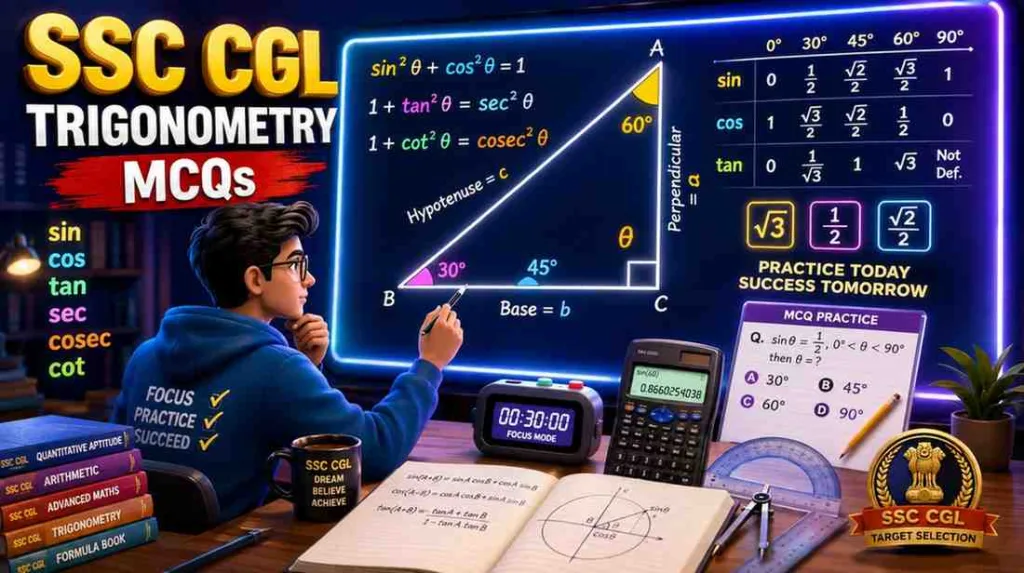
SSC CGL Trigonometry MCQs

30 SSC CGL Trigonometry MCQs:Powerful Questions for Success

Practice 30 SSC CGL Trigonometry MCQs with answers, detailed explanations, shortcuts, and Tier I & Tier II level questions for faster exam preparation SSC CGL Trigonometry MCQs   1. If sin θ = 3/ 5 , where θ  is acute, then tan θ: A) 3/4       B) 4/3 C) 3/5        D) 5/4 Correct Answer: A) 3/4  Explanation:  Given sin θ = 3/ 5 Using a right triangle Perpendicular = 3 Hypotenuse = 5 Base = √(52 –32) = √16 =4 tan θ =3/4 2. If tan θ = 5/12, then sec θ is: A) 12/13      B) 13/12 C) 5/13        D) 13/5 Correct Answer: B) 13/12 Explanation:  We know that 1+ tan2 θ = sec2 θ sec2 θ = 1+ 25/144 = 169/ 144 sec θ = 13/ 12 3. The value of sin300 cos600 + cos300 sin600 is: A)  0    B) 1/2 C) 1    D) √3/2 Correct Answer: C) 1 Explanation:   sin A cos B + cos A sin B= sin(A+B) sin300 cos600 + cos300 sin600 = sin (600 + 300) = sin900 =1 4. If cot θ = 7/24, then cosec θ is: A) 24/25     B) 25/24 C) 7/25      D) 25/7 Correct Answer: B) 25/24 Explanation:  cot θ = 7/ 24 perpendicular = 24 and base = 7 Hypotenuse =  √(72 + 242) = √625 = √25 cosec θ = 25/ 24 5. What is the value of   ? A) 0       B) 1 C) 2        D)3 Correct Answer: B) 1 Explanation:  We know that 1– cos2 θ = sin2 θ = 1 SSC CGL Trigonometry MCQs 6. If tan A = 1 and A is acute, then A equals: A)  30°    B)   45° C)   60°    D)   90° Correct Answer: B) 45° Explanation:  tan A = 1 tan A = tan450 A = 450 7. The value of sec2 450   –  tan2 450 is: A)  0    B)   1 C)   2    D)   √2 Correct Answer: B) 1 Explanation:  We know that  sec2θ – tan2θ =1 sec2 450   –  tan2 450 = 1 8. If sin A= cos 30 , where A is acute, then A is: A)  30°    B)   45° C)   60°    D)   90° Correct Answer: C) 60° Explanation:  sin (90 – θ) = cos θ cos30 = sin(90 – 30) = sin60 sin A= sin60 Since A is acute A = 60 9. If A + B = 90, then which of the following is always true? A) sin A = sin B    B) tan A = tan B C) sin A = cos B     D) cos A = cos B Correct Answer: C) sin A= cos B Explanation:  A + B = 90 A = 90 – B sin A = sin (90 – B) = cos B 10. If tan θ + cot θ = 2, then the value of tan θ is A) 1       B) 2 C) 1/2    D) 0 Correct Answer: A) 1 Explanation:  Let x= tan θ tan θ + cot θ = 2 tan θ + 1/tan θ = 2 x + 1/x = 2 x 2 + 1= 2x x 2– 2x+1=0 (x– 1)2= 0 x = 1 ∴ tan θ = 1 SSC CGL Trigonometry MCQs 11. The value of sin60/cos30is: A) 1/2      B) 1 C) √3      D) 2 Correct Answer: B) 1 Explanation:   sin60 = √3/2 and cos30 = √3/2 sin60/cos30 = (√3/2)/ (√3/2 ) = 1 SSC CGL Trigonometry MCQs 12. If sin θ + cos θ = √2 then θ, where (0 < θ < 90  ), is A) 30°        B) 45° C) 60°        D) 90° Correct Answer: B) 45° Explanation:   sin 450 + cos 450 = (1/√2) + (1/√2) = 2/√2 = √2 ∴ θ =45 13. If tan θ = 3/4, find A) – 7        B) 7 C) 1/7       D) – 1/7 Correct Answer: A) – 7 Explanation:  Given: tan θ =  3/4 sin θ = 3/5, cos θ =  4/5 14. The value of  is: A) tan2 θ    B) cot 2 θ C)   1         D) tan θ Correct Answer: A) tan 2 θ Explanation:  We know that 1+ tan 2 θ = sec 2 θ, 1+ cot 2 θ = cosec 2 θ = tan 2 θ 15. If sec θ + tan θ =3, then sec θ – tan θ is A) 1/3       B) 3 C) 2/3        D) 1 Correct Answer: A) 1/3 Explanation:  sec2 θ – tan2 θ = 1 (sec θ + tan θ) (sec θ – tan θ) = 1 3 (sec θ – tan θ) = 1 sec θ – tan θ = 1/3 SSC CGL Trigonometry MCQs 16. If sin θ =  5/13, then  = A) 25             B) 14 C) 26               D) 5 Correct Answer: A) 169/144   Explanation:  sin θ =   5/13 cos θ =   12/ 13 = 25 17. If tan A =1/2 and tan B =1/3, then tan(A+B) is A)  1         B)   5/6 C)   1/2     D)   6/5 Correct Answer: A) 1 Explanation:  = 1 18. If A + B = 45, tan A=2, then tan B is A) –1/3       B) 1/2 C) 2/3        D) – 3 Correct Answer: A) –1/3 Explanation: tan (A + B) = tan45   =1 1 – 2 tan B = 2 + tan B 1 – 2 = 2 tan B + tan B – 1 = 3 tan B tan B =– 1/3 19. A pole casts a shadow of length 10√3 m when the angle of elevation of the sun is 300. Find the height of the pole. A) 10 m      B) 20 m C) 30 m      D)15 m Correct Answer: A) 10 m Explanation:  Let height be h) tan30   =   h/10√3 1/√3 = h/10√3 h = 10m   20. From a point

30 SSC CGL Trigonometry MCQs:Powerful Questions for Success Read More »

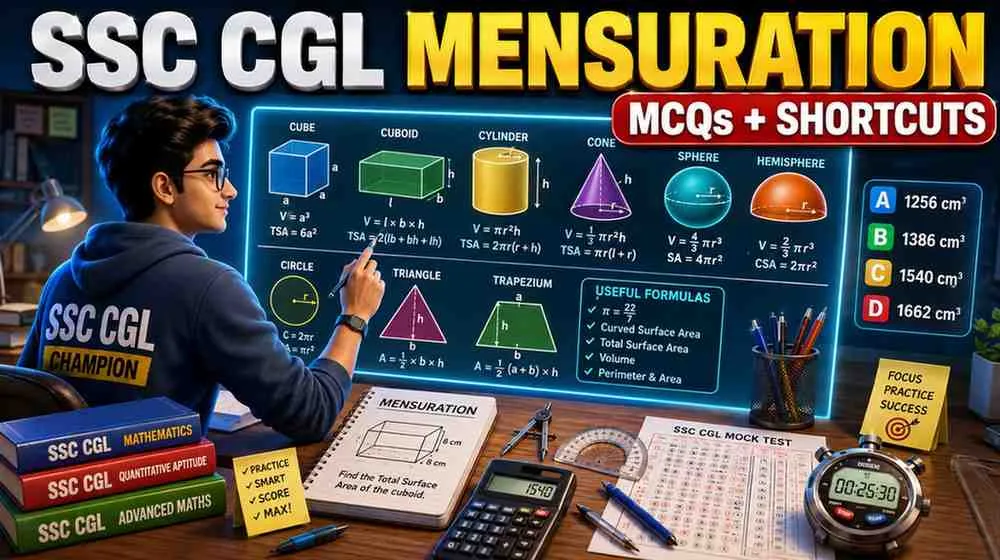
SSC CGL Mensuration MCQs

40 SSC CGL Mensuration MCQs: Score with Powerful Tricks

SSC CGL Mensuration MCQs with exam-oriented answers, detailed explanations, shortcut tricks, and Tier-I & Tier-II level practice for SSC CGL Maths preparation.   SSC CGL Mensuration MCQs   1. The length and breadth of a rectangle are in the ratio 5 : 3. If its area is 540 cm², what is its perimeter? A) 96 cm  B) 104 cm C) 108 cm  D) 112 cm Correct Answer: A) 96 cm Explanation: Let length = 5x and breadth = 3x Area = 5x × 3x = 15x² 15x² = 540 x² = 36 x = 6 Therefore, Length = 30 cm Breadth = 18 cm Perimeter = 2(l + b) = 2(30 + 18) = 96 cm 2. The diagonal of a square is 14√2 cm. What is its area? A) 98 cm²  B) 196 cm² C) 392 cm²  D) 49 cm² Correct Answer: B) 196 cm² Explanation: For a square Diagonal = side × √2 Side = 14√2 / √2 = 14 cm Area = side² = 14² = 196 cm² Shortcut: Area of square = d²/2 = (14√2)² / 2 = 392/2 = 196 cm² 3. The base of a triangle is 24 cm, and its corresponding height is 15 cm. Find its area. A) 160 cm²  B) 180 cm² C) 360 cm²  D) 190 cm² Correct Answer: B) 180 cm² Explanation: Area of triangle = ½ × base × height = ½ × 24 × 15 = 12 × 15 = 180 cm² 4. The parallel sides of a trapezium are 18 cm and 32 cm, and its height is 14 cm. Find its area. A) 320 cm²  B) 350 cm² C) 375 cm²  D) 400 cm² Correct Answer: B) 350 cm² Explanation: Area of trapezium = ½ × (sum of parallel sides) × height = ½ × (18 + 32) × 14 = ½ × 50 × 14 = 350 cm² 5. The area of a parallelogram is 420 cm². If its base is 28 cm, find the corresponding height. A) 12 cm  B) 15 cm C) 18 cm  D) 20 cm Correct Answer: B) 15 cm Explanation: Area = base × height 420 = 28 × h h = 420/28 = 15 cm SSC CGL Mensuration MCQs 6. The diagonals of a rhombus are 24 cm and 10 cm. Find its area. A) 100 cm²  B) 120 cm² C) 240 cm²  D) 60 cm² Correct Answer: B) 120 cm² Explanation: Area of rhombus = 1/2 × d₁ × d₂ = 1/2 × 24 × 10 = 120 cm² = 2 × 22/7 × 14 = 88 cm 7. A cylinder has a radius of 7 cm and a height of 10 cm. Find its volume. A) 1540 cm³  B) 770 cm³ C) 3080 cm³  D) 980 cm³ Correct Answer: A) 1540 cm³ Explanation: Volume = πr²h = 22/7 × 7² × 10 = 22 × 7 × 10 = 1540 cm³ 8. The radius of a cylinder is 7 cm, and its height is 15 cm. Find its curved surface area. A) 440 cm²  B) 660 cm² C) 770 cm²  D) 880 cm² Correct Answer: B) 660 cm² Explanation: CSA = 2πrh = 2 × 22/7 × 7 × 15 = 44 × 15 = 660 cm² 9. Find the volume of a cone having radius 6 cm and height 7 cm. A) 132 cm³  B) 264 cm³ C) 396 cm³  D) 792 cm³ Correct Answer: B) 264 cm³ Explanation: Volume of cone = 1/3πr²h = 1/3 × 22/7 × 36 × 7 = 22 × 12 = 264 cm³ SSC CGL Mensuration MCQs 10. A cone has a radius of 12 cm and a height of 5 cm. What is its slant height? A) 13 cm  B) 17 cm C) 10 cm  D) 7 cm Correct Answer: A) 13 cm Explanation: For a cone l² = r² + h² = 12² + 5² = 144 + 25 = 169 l = 13 cm SSC CGL Mensuration MCQs 11. Find the volume of a sphere of radius 3 cm. A) 36π cm³  B) 27π cm³ C) 18π cm³  D) 9π cm³ Correct Answer: A) 36π cm³ Explanation: Volume of sphere = 4/3πr³ = 4/3 × π × 3³ = 4/3 × π × 27 = 36π cm³ 12. Find the total surface area of a hemisphere of radius 7 cm. A) 154 cm²  B) 308 cm² C) 462 cm²  D) 616 cm² Correct Answer: C) 462 cm² Explanation: TSA of hemisphere = 3πr² = 3 × 22/7 × 49 = 462 cm² 13. The total surface area of a cube is 864 cm². Find its volume. A) 1728 cm³  B) 1296 cm³ C) 864 cm³  D) 216 cm³ Correct Answer: A) 1728 cm³ Explanation: TSA = 6a² 6a² = 864 a² = 144 a = 12 cm Volume = a³ = 12³ = 1728 cm³ 14. A cuboid has dimensions 12 cm, 9 cm, and 20 cm. Find its diagonal. A) 23 cm  B) 25 cm C) 29 cm  D) 31 cm Correct Answer: B) 25 cm Explanation: Diagonal: d = √(l² + b² + h²) = √(12² + 9² + 20²) = √(144 + 81 + 400) = √625 = 25 cm 15. A cube is painted on all its faces and then divided into 125 equal smaller cubes. How many smaller cubes have exactly two faces painted? A) 24  B) 36 C) 48  D) 60 Correct Answer: C) 36 Explanation: 125 = 5³ So the large cube is divided into 5 × 5 × 5 cubes. Cubes having exactly two faces painted lie along the edges, excluding the corner cubes. Number = 12(n − 2) = 12(5 − 2) = 36 16 A rectangular garden is 40 m long and 30 m wide. A path of width 2 m is constructed outside the garden. Find the area of the path. A) 296 m²  B) 300 m² C) 304 m²  D) 320 m² Correct Answer: A) 296 m². Explanation: Outer length = 40 +

40 SSC CGL Mensuration MCQs: Score with Powerful Tricks Read More »

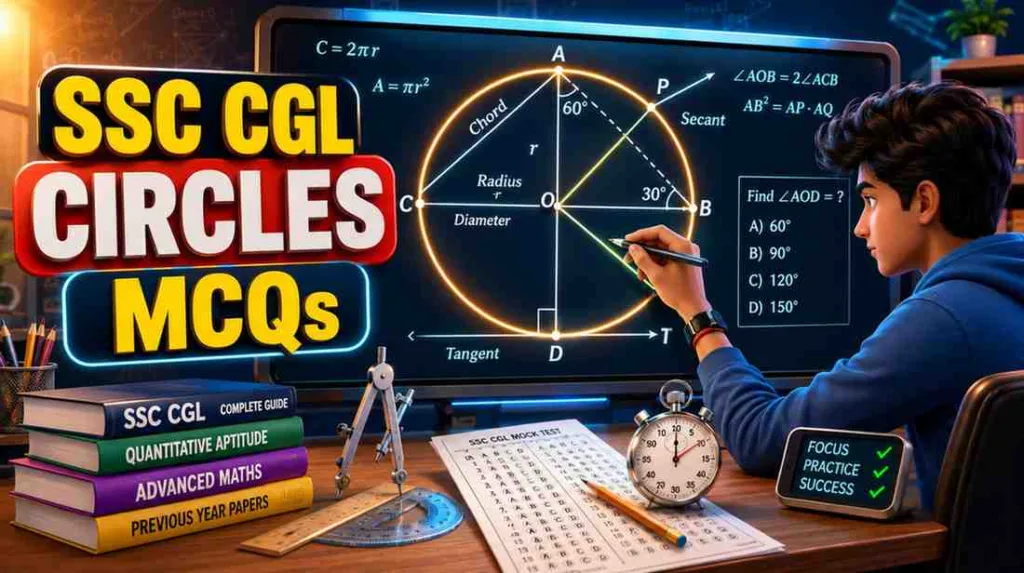
SSC CGL Circles MCQs

SSC CGL Circles MCQs Powerful Questions Master Geometry26

SSC CGL Circles MCQs with exam-oriented questions, detailed solutions, shortcut tricks and Tier-I & Tier-II practice for faster and more accurate preparation. SSC CGL Circles MCQs   1. A tangent to a circle at point P is perpendicular to the radius drawn through P. If OP = 7 cm, where O is the centre, then the angle between OP and the tangent at P is A) 45°  B) 60° C) 90°  D) 180° Correct Answer: C) 90° Explanation: The radius drawn to the point of contact of a tangent is always perpendicular to the tangent. ∴ ,∠OPT = 90° 2. From an external point P, a tangent PA is drawn to a circle with centre O. If OP = 13 cm and radius = 5 cm, find PA A) 8 cm  B) 10 cm C) 12 cm  D) 18 cm Correct Answer: C) 12 cm Explanation: OA ⟂ PA By Pythagoras theorem PA² = OP² − OA² = 13² − 5² = 169 − 25 = 144 ∴ PA = 12 cm 3. Two tangents PA and PB are drawn from an external point P to a circle. If PA = 9 cm, then PB is A) 4.5 cm  B) 9 cm C) 18 cm  D) Cannot be determined Correct Answer: B) 9 cm Explanation: Tangents drawn from the same external point to a circle are equal. PA = PB = 9 cm 4. The radius of a circle is 14 cm. Find its circumference. Take π = 22/7 A) 44 cm  B) 66 cm C) 88 cm  D) 176 cm Correct Answer: C) 88 cm Explanation: Circumference = 2πr = 2 × 22/7 × 14 = 88 cm 5. The area of a circle is 154 cm². Find its radius. Take π = 22/7 A) 5 cm  B) 6 cm C) 7 cm  D) 14 cm Correct Answer: C) 7 cm Explanation: πr² = 154 (22/7)r² = 154 r² = 49 r = 7 cm SSC CGL Circles MCQs 6. The radii of two circles are in the ratio 3 : 5. What is the ratio of their circumferences? A) 3 : 5  B) 9 : 25 C) 5 : 3  D) 6 : 25 Correct Answer: A) 3 : 5 Explanation: Circumference = 2πr Circumference is directly proportional to radius C₁ : C₂ = r₁ : r₂ = 3 : 5 7. The radii of two circles are in the ratio 2 : 3. Find the ratio of their areas A) 2 : 3  B) 4 : 9 C) 3 : 2  D) 8 : 27 Correct Answer: B) 4 : 9 Explanation: Area ∝ r² A₁ : A₂ = 2² : 3² = 4 : 9 8. The diameter of a circle is 28 cm. Its area is A) 154 cm²  B) 308 cm² C) 616 cm²  D) 1232 cm² Correct Answer: C) 616 cm² Explanation: Radius = 28/2 = 14 cm Area = πr² = 22/7 × 14 × 14 = 616 cm² 9. The radius of a semicircle is 14 cm. Find its perimeter A) 44 cm  B) 58 cm C) 72 cm  D) 88 cm Correct Answer: B) 72 cm Explanation: Perimeter of semicircle = πr + 2r = 22/7 × 14 + 28 = 44 + 28 = 72 cm 10. A chord of a circle passes through the centre. Such a chord is called A) Radius  B) Tangent C) Diameter  D) Secant Correct Answer: C) Diameter Explanation: A chord passing through the centre of a circle is called the diameter A diameter is the longest chord of a circle 11. A perpendicular drawn from the centre of a circle to a chord A) Doubles the chord             B) Bisects the chord C) Is parallel to the chord      D) Is always equal to the chord Correct Answer: B) Bisects the chord Explanation: The perpendicular from the centre of a circle to a chord bisects the chord. If OM ⟂ AB, then AM = MB SSC CGL Circles MCQs 12. Two equal chords of a circle are A) Equidistant from the centre          B) Always diameters C) Perpendicular to each other        D) Parallel to each other Correct Answer: A) Equidistant from the centre Explanation: Equal chords of the same circle are equidistant from the centre Conversely, chords equidistant from the centre are equal 13. An arc of a circle subtends an angle of 80° at the circumference. What angle does the same arc subtend at the centre? A) 40°  B) 80° C) 160°  D) 240° Correct Answer: C) 160° Explanation: Angle at centre = 2 × angle at circumference = 2 × 80° = 160° 14. An angle subtended by a diameter at any point on the circle is A) 30°  B) 45° C) 60°  D) 90° Correct Answer: D) 90° Explanation: According to the theorem, the angle in a semicircle is always a right angle Required angle = 90° 15. ABCD is a cyclic quadrilateral. If ∠A = 75°, find ∠C A) 75°  B) 90° C) 105°  D) 115° Correct Answer: C) 105° Explanation: Opposite angles of a cyclic quadrilateral are supplementary ∠A + ∠C = 180° 75° + ∠C = 180° ∠C = 105°   SSC CGL Circles MCQs   16. In a cyclic quadrilateral, ∠A = 2x and ∠C = 3x. Find x A) 30°  B) 36° C) 40°  D) 45° Correct Answer: B) 36° Explanation: Opposite angles are supplementary 2x + 3x = 180° 5x = 180° x = 36° SSC CGL Circles MCQs 17. The angle between a tangent and a chord through the point of contact is equal to A) Angle at the centre                                         B) Angle in the alternate segment C) Double the angle in the alternate segment       D) 90° always Correct Answer: B) Angle in the alternate segment Explanation: By the tangent-chord theorem, the angle between a tangent and a chord equals the angle subtended by that chord in the alternate segment. 18. A tangent touches a circle at P. If

SSC CGL Circles MCQs Powerful Questions Master Geometry26 Read More »

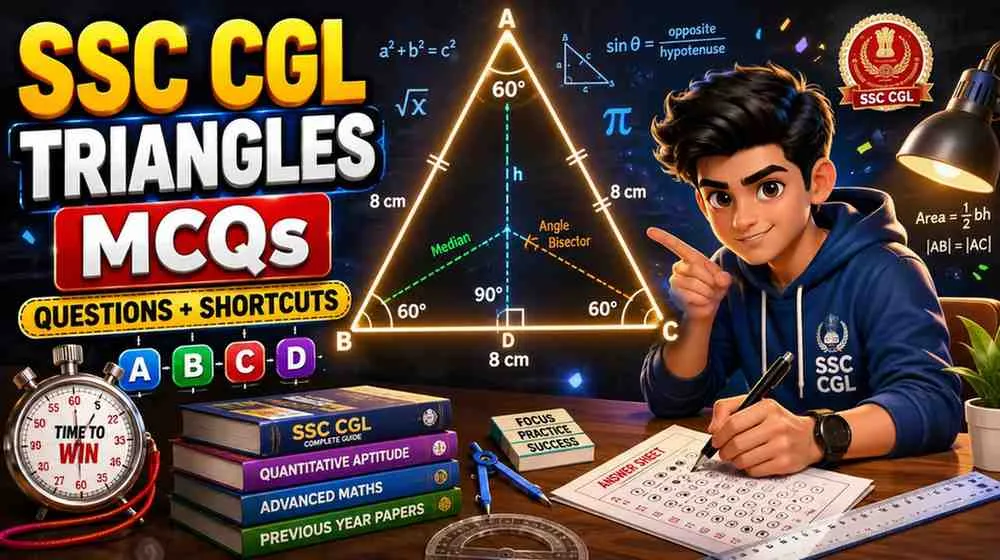
SSC CGL Triangles MCQs 5

SSC CGL Triangles MCQs| Powerful Practice Questions

SSC CGL Triangles MCQs 5SSC CGL Triangles MCQs with 20 exam-oriented questions, answers, detailed explanations, and shortcut tricks for Tier-I and Tier-II preparation SSC CGL Triangles MCQs   1. The angles of a triangle are in the ratio 2 : 3 : 4. The largest angle is A) 60°  B) 70° C) 80°  D) 90° Correct Answer: C) 80° Explanation: Sum of angles of a triangle = 180° Total parts = 2 + 3 + 4 = 9 One part = 180°/9 = 20° Angles are 2 × 20 = 40; 3 × 20 = 60; 4 × 20 = 80 Largest angle = 4 × 20° = 80°   2. In ΔABC, ∠A = 55° and ∠B = 65°. The exterior angle at C is A) 110°  B) 115° C) 120°  D) 125° Correct Answer: C) 120° Explanation: Exterior angle = Sum of its opposite interior angles = ∠A + ∠B = 55° + 65° = 120°   3 In an isosceles triangle, the unequal angle is 40°. Each equal angle is A) 60°  B) 65° C) 70°  D) 75° Correct Answer: C) 70° Explanation: Equal angles = x 2x + 40° = 180° 2x = 140° x = 70°   4. The hypotenuse of a right-angled triangle is 13 cm and one side is 5 cm. The other side is A) 10 cm  B) 11 cm C) 12 cm  D) 14 cm Correct Answer: C) 12 cm Explanation: By Pythagoras theorem 13² = 5² + x² 169 = 25 + x² x² = 144 x = 12 cm   5. The area of an equilateral triangle is 144√3 cm². Its side is A) 12 cm  B) 18 cm C) 24 cm  D) 36 cm Correct Answer: C) 24 cm Explanation: Area of equilateral triangle =   a2 144 √3=  a2 a² = 576 a = 24 cm   6. Two similar triangles have corresponding sides in the ratio 3 : 5. The ratio of their areas is A) 3 : 5  B) 6 : 10 C) 9 : 25  D) 27 : 125 Correct Answer: C) 9 : 25 Explanation For similar triangles Ratio of areas = Square of the ratio of corresponding sides. A1/A2 = (3/5 )2 = 9/25 A1:A2 = 9 : 25   7. Two similar triangles have areas 64 cm² and 100 cm². The ratio of their corresponding sides is A) 4 : 5  B) 8 : 10 C) 16 : 25  D) 3 : 4 Correct Answer: A) 4 : 5 Explanation:   Ratio of corresponding sides Ratio of corresponding sides = 4 : 5   8. In ΔABC, AB = 7 cm, AC = 9 cm, and BC = 8 cm. The median drawn to side BC divides BC into A) 2 cm and 6 cm       B) 3 cm and 5 cm C) 4 cm and 4 cm      D) 1 cm and 7 cm Correct Answer: C) 4 cm and 4 cm Explanation: A median always divides the opposite side into two equal parts BC = 8 cm Each part = 8/2 = 4 cm   9. The centroid of a triangle divides each median in the ratio A) 1 : 1  B) 1 : 2 C) 2 : 1  D) 3 : 1 Correct Answer: C) 2 : 1 Explanation: The centroid divides every median in the ratio 2 : 1 The longer portion lies between the vertex and centroid Shortcut: Remember Centroid = 2 : 1   10. A right-angled triangle has sides 6 cm, 8 cm and 10 cm. Its inradius is A) 1 cm  B) 2 cm C) 3 cm  D) 4 cm Correct Answer: B) 2 cm Explanation: For a right triangle r= (a + b – c)/2[ r = (6 + 8 –10)/2 = 4/2 =2 ∴ inradius = 2 cm   11. The circumradius of a right-angled triangle whose hypotenuse is 18 cm is A) 6 cm  B) 9 cm C) 12 cm  D) 18 cm Correct Answer: B) 9 cm Explanation: In a right-angled triangle, mid- point of hypotenuse is the Circumcentre Circum Radius = (Length of Hypotenuse)/2 = 18/2 = 9   12. Which of the following can form a triangle? A) 2 cm, 3 cm, 6 cm         B) 4 cm, 5 cm, 10 cm C) 5 cm, 6 cm, 10 cm       D) 1 cm, 2 cm, 4 cm Correct Answer: C) 5 cm, 6 cm, 10 cm Explanation: For a triangle: Sum of any two sides of a tringle is greater than the third side For option C: 5 + 6 > 10; 6 + 10 > 5 ; 5 + 10 > 6 Therefore, it can form a triangle   13.In ΔABC, AD bisects ∠A. If AB = 6 cm, AC = 9 cm and BC = 10 cm, then BD : DC is A) 2 : 3  B) 3 : 2 C) 1 : 2  D) 2 : 1 Correct Answer: A) 2 : 3 Explanation: BD/DC = AB/AC = 6/9 = 2/3 ∴ BD : DC = 2 : 3   14. The base of a triangle is 18 cm and its height is 14 cm. Its area is A) 112 cm²  B) 126 cm² C) 144 cm²  D) 252 cm² Correct Answer: B) 126 cm² Explanation: Area   = 1/2  (base)× (height) = 1/2 (18 ×14) =9×14 =126 cm2   15. The sides of a triangle are 13 cm, 14 cm and 15 cm. Its area is A) 72 cm²  B) 84 cm² C) 96 cm²  D) 105 cm² Correct Answer: B) 84 cm² Explanation: s= (13+14+15)/2=21 ∴ Area of triangle = 84 cm²   16. Two similar triangles have corresponding sides in the ratio 2 : 3. If the perimeter of the smaller triangle is 24 cm, the perimeter of the larger triangle is A) 30 cm  B) 32 cm C) 36 cm  D) 40 cm Correct Answer: C) 36 cm Explanation: Perimeters of similar triangles are in the same ratio as corresponding sides 24/P= 2/3 P=24 × 3/2=36 ∴ 36 cm.    17. A right-angled triangle has hypotenuse 25 cm and one side 7 cm. Its

SSC CGL Triangles MCQs| Powerful Practice Questions Read More »

Scroll to Top