Nayini Satyanarayana Reddy

20 SSC CGL Linear Equations MCQs: Powerful Questions

SSC CGL Linear Equations MCQs with 20 exam– oriented questions, answers, detailed explanations, shortcut tricks, and Tier– I & Tier– II practice for competitive exams. SSC CGL Linear Equations MCQs   1. If 3x + 7 = 25, then the value of x is: A) 5  B) 6 C) 7  D) 8 Correct Answer: B) 6 Explanation:   3x + 7=25 3x = 25 – 7=18 x=6   2. If 5x – 3 = 2x + 12, then value of  x is: A) 4  B) 5 C) 6  D) 7 Correct Answer: B) 5 Explanation: 5x– 3=2x+12 5x– 2x=12+3 3x=15 x=5   3. The value of x satisfying  x/3 + 5 = 11 is: A) 12  B) 15 C) 18  D) 21 Correct Answer: C) 18 Explanation:   x/3 + 5 = 11 x/3  = 11– 5 = 6 x = 18   4. If 2(x + 5) = 3(x – 2)), then value of x is: A) 14  B) 16 C) 18  D) 20 Correct Answer: C) 16 Explanation: 2x + 10 = 3x – 6 10 + 6 = 3x –  2x x=16     5. If 0.4x+2.8=6.8, then x is: A) 8  B) 9 C) 10  D) 12 Correct Answer: C) 10 Explanation: 0.4x = 6.8 – 2.8 = 4 x= 4/ 0.4 =10   6. If (2x – 3)/ 5 =7, find (x) A) 16  B) 17 C) 18  D) 19 Correct Answer: B) 19 Explanation: (2x – 3)/ 5 =7 2x – 3=35 2x = 38 x = 19   7. The sum of a number and itsone–third is 40. The number is: A) 24  B) 27 C) 30  D) 32 Correct Answer: C) 30  Explanation: Let the number be (x) x + x /3 = 40 4x / 3 = 40 x = 30 SSC CGL Linear Equations MCQs 8. Three times a number exceeds the number by 48. Find the number. A) 20  B) 22 C) 24  D) 26 Correct Answer: C) 24 Explanation: 3x – x = 48 2x = 48 x = 24   9. The sum of two consecutive integers is 57. The larger integer is: A) 27  B) 28 C) 29  D) 30 Correct Answer: C) 29 Explanation: Let the integers be x and x+1 x + x + 1=57 2x = 56 x = 28 Larger integer = 28 + 1 =29   10. The sum of three consecutive integers is 96. The middle integer is: A) 30  B) 31 C) 32  D) 33 Correct Answer: C) 32 Explanation: For three consecutive integers, the middle number equals their average. 96/ 3 =32 ∴  The middle integer is  32   11. A number is increased by 20% and becomes 72. The original number is A) 50  B) 55 C) 60  D) 65 Correct Answer: C) 60 Explanation: After 20% increase 120% of original =72 120x/100 =72 x=60 SSC CGL Linear Equations MCQs 12. A number decreased by 25% becomes 90. Find the original number A) 110  B) 115 C) 120  D) 125 Correct Answer: C) 120 Explanation: After 25% decrease, 75% remains 75% of x=90 x=  (90 ×100)/  75 =120   13. If [(x– 2)/ 3] +  [(x+1)/ 2] = 9, then x is: A) 10  B) 12 C) 11  D) 13 Correct Answer: C) 11 Explanation: [(x– 2)/ 3] +  [(x+1)/ 2] = 9 LCM of 3 and 2 = 6 [2(x– 2)+3(x+1)]/6=9 2x – 4 + 3x + 3 =54 5x– 1=54 5x=55 x=11   14. A father is 3 times as old as his son. Their total age is 64 years. The son’s age is A) 14  B) 16 C) 18  D) 20   Correct Answer: B) 16  Explanation: Let son’s age = (x) Father’s age = (3x) x + 3x=64 4x=64 x=16   15. The present age of A is twice that of B. After 5 years, their total age will be 70 years. B’s present age is A) 18  B) 20 C) 22  D) 25 Correct Answer: B) 20 Explanation: Let B’s age = (x) A’s age = (2x) After 5 years (x + 5)+(2x + 5)=70 3x+10=70 3x=60 x=20 SSC CGL Linear Equations MCQs 16. The perimeter of a rectangle is 84 cm. If its length is 4 cm more than its breadth, the breadth is A) 17 cm  B) 18 cm C) 19 cm  D) 20 cm Correct Answer: B) 19 cm Explanation: Let breadth = (x) Length = (x + 4) 2(l + b) = 84 l + b=42 x + 4 + x=42 2x=38 x=19 SSC CGL Linear Equations MCQs 17. A number, when multiplied by 7 and decreased by 9, gives 40. The number is A) 5  B) 6 C) 7  D) 8 Correct Answer: B) 7  Explanation: 7x– 9=40 7x=49 x=7   18. If 4x+5=2x+17, then the value of (3x– 4) is A) 12  B) 14 C) 16  D) 18   Correct Answer: C) 14 Explanation: 4x+5=2x+17 2x=12 x=6 ∴ 3x– 4=18– 4=14   19. A number is such that one – fourth of it exceeds one – sixth of it by 10. The number is A) 100  B) 110 C) 120  D) 140 Correct Answer: C) 120 Explanation:   x/4 – x/ 6 =10 LCM = 12 (3x– 2x)/12 =10 x=120 SSC CGL Linear Equations MCQs 20. A shopkeeper gives a discount of ₹120 on an article and sells it for ₹480. If the marked price is (x), which equation represents the situation? A) x+120=480  B) x– 120=480 C) 120x=480  D) x/120=480 Correct Answer: B) x– 120=480  Explanation: Selling Price = Marked Price − Discount ∴ x– 120=480   21. The average of five consecutive integers is 42. The largest integer is A) 43  B) 44 C) 45  D) 46 Correct Answer: B) 44 Explanation: For an odd number of consecutive integers, the average is the middle number So the five numbers are: 40,41,42,43,44 Largest =  44   22. A two-digit number has its tens digit 3 more than its units digit. The sum of its digits is 11. The number is A) 47  B) 56 C) 65  D) 74 Correct Answer: D) 74 Explanation: Let the units digit = x Tens digit = x+3 Given x+(x+3)=11 2x=8 x=4 ∴ tens digit = 7 Number =  74     SSC CGL Linear Equations

20 SSC CGL Linear Equations MCQs: Powerful Questions Read More »
SSC CGL Elementary Surds

30 SSC CGL Elementary Surds: Powerful Questions

SSC CGL Elementary Surds with 30 exam-oriented questions, detailed solutions, shortcuts, and Tier-I & Tier-II practice for faster and more accurate preparation.   SSC CGL Elementary Surds   1. Simplify A) 6√3         B) 7√3 C) 8√3       D) 9√3 Correct Answer: A)  6√3 Explanation: 2. Rationalise the denominator: A) √7 + √2              B) √7 –  √2 C)√2 – √ 7            D) √5 Correct Answer: B) √7 –  √2 Explanation:      = √7 –  √2 3. Find the value of: A) 8 + 2√15         B) 8 + √15 C) 2 + 2√15       D) 8 – 2√15 Correct Answer: A) 8 + 2√15 Explanation: (a + b)2= a2  + b2 + 2ab = 8 + 2√15   4. Simplify: A) 2                B) 12 C) √2            D) 24 Correct Answer: A) 2 Explanation: (a + b)(a – b)=a2 – b2 7– 5 = 2   5. If x = √7 + √6 then the value of  x + 1/x  is A) 2 √7                 B) 2 √6 C) √7   + √6         D) 7+ √6 Correct Answer: A) 2 √7 Explanation: x = √7 + √6 = √7 – √6 x + 1/x = √7 + √6 + √7 – √6 = 2√7 6  Evaluate: A) √3 + √2          B) √3 – √2 C) 1                   D) √6– 1 Correct Answer: B) √3 – √2 Explanation: = √3 – √2 7.  Simplify:    A) 3√2         B) 4√2 C) 5√2       D) 3√2 Correct Answer: B)  4√2 Explanation: SSC CGL Elementary Surds  8.  If a= √5 + √2 and b=√5 – √2, then the value of ab is A) 3                B) 5 C) 7              D) √3 Correct Answer: A) 3 Explanation: ab = (√5 – √2)( √5 – √2) = (√5)2 – (√2)2 = 5 – 2 = 3  9. Find: (√2 + 1) (√2 – 1) A) 0                B) 1 C) 2               D) √2 Correct Answer: B) 1 Explanation: (√2 + 1) (√2 – 1)=  (√2)2 – 12 =2–1 =1 10.  Simplify: A) (3 + √5)/2     B) (5 + √5)/2 C) 3 + √5           D) 2 + √5 Correct Answer: A) (3 + √5)/2 Explanation: = (3 + √5)/2 SSC CGL Elementary Surds 11.  If x= √3 + √2, then find x2 A) 5 + √6                 B) 5+2√6 C) 6 + √5              D) (5 – 2√6) Correct Answer: B) 5+2√6 Explanation: x= √3 + √2 x2= (√3 + √2)2 = 3 + 2 + 2√6 = 5 + 2√6 12 Evaluate: (√3+ √2)2– (√3 – √2)2 A) 2√6                B) 4√6 C) 6√2              D) 10 Correct Answer: B) 4√6 Explanation: Use:(a + b)2– (a – b)2=4ab a=√3, b=√2 (√3+ √2)2– (√3 – √2)2 = 4√3 × √2 =4√6   13 Simplify: √(12) ×√(27) A) 9                          B) 12 C) 18                        D) 36 Correct Answer: C) 18 Explanation: √(12) ×√(27) = √(12 × 27) = √(324)=18 14 Find the value of: frac(√6)/(√3) A) √2                    B) 2 C) √3                   D) 3 Correct Answer: A) √2 Explanation: (√6)/(√3) =√(6/3) =√2 SSC CGL Elementary Surds 15.  If x=√2+√3, then find: x2 – 2√6. A) 2                     B) 3 C) 5                     D) 6 Correct Answer: C) 5 Explanation: x2 = (√2 + √3)2 = 2 + 3 + 2√6 = 5 + 2√6 x2 – 2√6 = 5   16. Rationalise: 3/(2+√3) A) 6 – 3√3                    B) 6 + 3√3 C) 3 – √3                      D) 2 – √3 Correct Answer: A) 6 – 3√3 Explanation: 3/(2+√3) = [3/(2+√3)][ (2 – √3/(2+√3)] = [3(2–√3)]/(4–3) =6 – 3√3   17.  Find: (√5 + √3)(√5 + √3) A) 8 + 2√(15)                    B) 8 + √(15) C) 2 + 2√(15)                    D) 5 + 3√(15) Correct Answer: A) 8+2√(15) Explanation: (√5+√3)2 = 5 + 3 + 2√(15) =8 + 2√(15)   18. Which of the following is a rational number? A) √2 + √3               B) √5 – √2 C) √7×√7               D) √3 + √6 Correct Answer: C) √7×√7 Explanation: √7×√7 =7 Which is rational. The other expressions remain irrational.   19 Simplify: 1/(√5 – √3) A) (√5+√3)/2                          B) √5 + √3 C) (√5 – √3)/2                        D) 2 Correct Answer: A) (√5+√3)/2 Explanation: 1/(√5–√3) = [1/(√5–√3)] × (√5+√3)/(√5+√3) = (√5+√3)/(5–3) = (√5 + √3)/2   20.  If  a=√3+√2, then find a – 1/a A) (√3+√2)/2          B) (√3+√2) C) 2√3                    D) 2√2 Correct Answer: D) 2√2 Explanation: 1/a =1/(√3+√2) =√3 – √2 a – 1/a = (√3 + √2) – (√3 – √2) =2√2 SSC CGL Elementary Surds 21.  Evaluate:  (√7 + √2)2 + (√7 – √2)2 A) 14                         B) 18 C) 20                        D) 56 Correct Answer: C) 18 Explanation: (a + b)2+ (a – b)2=2(a2 + b2) (√7 + √2)2 + (√7 – √2)2 = 2[(√7)2 + (√2)2] 2(7 + 2)=18   22. Simplify:  [√8 + √(18)]/(√2) A) 3                  B) 5 C) 7                D) 5√2 Correct Answer: B) 5 Explanation: √8 = 2√2 and  √(18) = 3√2 [√8 + √(18)]/(√2)  = [2√2 + 3√2)]/√2 = (5√2)/(√2)=5      23.  If  x=√5 – √2, then x2 is: A) 7– 2√(10)                 B)

30 SSC CGL Elementary Surds: Powerful Questions Read More »
SSC CGL Basic Algebraic Identities MCQs

20 Powerful SSC CGL Basic Algebraic Identities Mcqs

Practice SSC CGL Basic Algebraic Identities MCQs with 20 latest questions, detailed solutions, shortcut tricks, and exam-oriented explanations based on the latest SSC CGL pattern.   SSC CGL Basic Algebraic Identities MCQs   1. If x +1/x = 5, then the value of x2 +1/x2 is. A) 21  B) 23 C) 25  D) 27 Correct Answer: B) 23 Explanation: (x +1/x)2 = 52 ⟹ x2 + 2 (x)(1/x) + 1/x2 = 25 ⟹  x2 +  2 + 1/x2 = 25 ⟹  x2 + 1/x2 = 25 – 2 = 23 2. If a – b = 8 and ab=9, then find (a2+b2). A) 70  B) 78 C) 82  D) 86 Correct Answer: C) 82 Explanation: a – b = 8 (a – b)2 = 82 a2 – 2ab + b2 = 64 a2 – 2(9) + b2 = 64 a2 – 18 + b2 = 64 a2 + b2 = 64 + 18 a2 + b2 = 82 3. Evaluate: 992 A) 9800  B) 9801 C) 9901  D) 9810 Correct Answer: B) 9801 Explanation: 992 = (100 –1)2 =10000 –200+1 =9801 4. Find 1032 A) 10509  B) 10609 C) 10809  D) 10909 Correct Answer: B) 10609 Explanation: 1032 = (100 + 3)2 =10000 + 600 + 9 =10609 SSC CGL Basic Algebraic Identities MCQs 5. If x – y = 4, x + y = 10, then find xy. A) 18  B) 20 C) 21  D) 24 Correct Answer: C) 21 Explanation: We know that (x + y)2 – (x – y)2 = 4xy ⟹ 100–16 = 4xy 84 = 4xy[ ⟹ xy=21 6. The value of 48 × 52 is A) 2496  B) 2500 C) 2490  D) 2484 Correct Answer: A) 2496 Explanation: 48 × 52 = (50 – 2)(50 + 2) =2500 – 4 =2496 7. If a+1/a=4 then find a3+1/a3 A) 52  B) 56 C) 60  D) 64 Correct Answer: A) 52 Explanation: We know that a3 + b3 = (a + b)(a2 – ab + b2) a2+1/a2 = (a + 1/a)2 – 2 =16 – 2=14 Now a3+1/a3 = (a + 1/a)(a2 – a(1/a) + (1/a)2) a3+1/a3 = 4(a2 – 1 + 1/a2) a3+1/a3 = 4(a2 + 1/a2 – 1) a3+1/a3 = 4(14 – 1) a3+1/a3 = 4(13) = 52 8. Evaluate 1012 – 992 A) 200  B) 400 C) 600  D) 800 Correct Answer: B) 400 Explanation: We know that a2 – b2 = (a + b) (a – b) 1012 – 992 = (101 + 99) (101 – 99) 1012 – 992 = (200) (2) = 400 9. If a + b=12, ab=20, the value of a2+b2 is A) 96  B) 100 C) 104  D) 108 Correct Answer: C) 104 Explanation: a2 + b2 = (a + b)2 – 2ab =144 –  40=104 SSC CGL Basic Algebraic Identities MCQs 10. The value of (2x+3)2 is A) (4×2 + 9)               B) (4×2+12x + 9) C) (2×2+12x + 9)       D) (4×2+6x + 9) Correct Answer: B Explanation: We know that (a + b)2=a2 + 2ab + b2 (2x+3)2 = (2x)2 + 2(2x)(3) + (3)2 (2x+3)2 = 4×2 + 12x + 9 11. Evaluate 9992 A) 998001  B) 999001 C) 997001  D) 998999 Correct Answer: A Explanation: (1000 –1)2 =1000000 – 2000+1 =998001 12. If x +1/x = 6 , then find x2+1/x2 A) 30  B) 32 C) 34  D) 36 Correct Answer: C Explanation: x2+1/x2 = (x + 1/x)2 – 2 = 36 – 2 = 34 13. Evaluate 752 A) 5525  B) 5625 C) 5725  D) 5825 Correct Answer: B Explanation[ (70 + 5)2 = 4900 + 700 + 25 =5625 14. Simplify (a + b)2 – (a – b)2 A) 2ab              B) 4ab C) a2 + b2       D) 2(a + b) Correct Answer: B Explanation: (a + b)2 – (a – b)2 = 4ab SSC CGL Basic Algebraic Identities MCQs 15. Evaluate 198 × 202 A) 39996  B) 40000 C) 39992  D) 39990 Correct Answer: A Explanation: 198 × 202 = (200 – 2) (200 + 2) = 40000 – 4 =39996 16. If a + b=7, a2 + b2=29, then the value of ab is A) 8  B) 9 C) 10  D) 11 Correct Answer: C Explanation: a + b=7 (a + b)2 =72 a2 + b2 + 2ab = 49 29+2ab = 49 2ab=20 ab=10 SSC CGL Basic Algebraic Identities MCQs 17. Expand (x – 5)2 A) (x2 –10x + 25)        B) (x2+10x + 25) C) (x2 – 25)                 D) (x2 – 5x + 25) Correct Answer: A Explanation:[ (a – b)2 = a2 – 2ab + b2 (x – 5)2 = x2 – 2x(5) + (5)2 = x2 – 10x + 25 18. Evaluate 49 × 51 A) 2499  B) 2501 C) 2498  D) 2500 Correct Answer: A Explanation: 49 × 51  = (50 – 1)(50 + 1) =2500 – 1 =2499 19. If x – 1/x = 2,  find x2 + 1/x2 A)  4    B)   5 C)   6    D)   7 Correct Answer:   C) 6   Explanation:    x – 1/x = 2    (x – 1/x)2 = 22    x2 – 2x(1/x) + (1/x)2 = 4    x2 – 2 + 1/x2 = 4    x2 + 1/x2 = 6 20. If x + 1/x = 2, find  x3 + 1/x3. A)  1    B)   2 C)   3    D)   4 Correct Answer:     B) 2   Explanation: We know that a3 + b3 = (a + b)(a2 – ab + b2) x2+1/x2 = (x + 1/x)2 – 2 =4 – 2= 2 Now x3+1/x3 = (x + 1/x)(x2 – x(1/x) + (1/x)2) x3+1/x3 = 2(x2 – 1 + 1/x2) x3+1/x3 = 2(x2 + 1/x2 – 1) x3+1/x3 = 2(2 – 1) x3+1/x3 = 2(1) = 2   SSC CGL Basic Algebraic Identities MCQs     SSC CGL Basic Algebraic Identities MCQs     SSC CGL Quantitative Aptitude Topics Number System Decimals Fractions Percentages Ratio & proportion Square roots Averages Interest (simple & compound) Profit & loss Discount Partnerships Mixture & Alligation Time & speed & distance Time & work Advanced math includes basic algebraic identities Elementary

20 Powerful SSC CGL Basic Algebraic Identities Mcqs Read More »

SSC CGL Time and Work MCQs

20 Powerful SSC CGL Time and Work MCQs with Solutions

Practice SSC CGL Time and Work MCQs with detailed solutions, shortcut tricks, and previous-year exam-level questions. Perfect for SSC CGL 2026 preparation, mock tests, YouTube quizzes, and PDFs.   SSC CGL Time and Work MCQs   1. A can complete a work in 20 days and B in 30 days. They work together for 6 days. The remaining work is completed by C alone in 8 days. In how many days can C alone complete the entire work? A. 20                   B. 16 C. 30                 D. 40 Correct Answer: B Explanation: A’s work/day = 1/20 B’s work/day = 1/30 Together = 1/12 Work done in 6 days = 6/12 = 1/2 Remaining = 1/2 C completes 1/2 work in 8 days. Entire work = 16 days? Rate of C = (1/2)/8 = 1/16 Hence, C alone takes 16 days. 2. A completes a work in 18 days while B takes 24 days. They work together for 6 days. What fraction of work remains? A. 1/6                  B. 5/12 C. 7/12                D. 1/2 Correct Answer: B Explanation Combined rate =1/18+1/24 =7/72 Work in 6 days =42/72 =7/12 Remaining =5/12 3. 12 men can complete a work in 18 days. How many men are required to complete the same work in 9 days? A. 18           B. 20 C. 24           D. 28 Correct Answer: C Explanation: Men × Days = Constant 12×18 = M×9 M = 24 4. A is twice as efficient as B. If B completes a work in 24 days, then A alone will complete it in A. 10         B. 12 C. 16         D. 18 Correct Answer: B Explanation: Efficiency doubles ⇒ Time halves 24/2 =12 days SSC CGL Time and Work MCQs   5. A can complete a work in 15 days and B in 10 days. They work together. In how many days will the work finish? A. 5               B. 6 C. 7              D. 8 Correct Answer: B Explanation: Combined rate =1/15 + 1/10 = 5/30 = 1/6 Time = 6 days. 6. If A:B efficiency ratio is 3:5, then their time ratio is A. 3:5             B. 5:3 C. 2:3            D. 1:2 Correct Answer: B Explanation: Time is inversely proportional to efficiency 7. 20 workers complete a work in 15 days. After 5 days, 5 workers leave. Remaining work will be completed in A. 12 days         B. 13⅓ days C. 15 days        D. 10 days Correct Answer: B Explanation: Total work = 20 × 15 = 300 Done = 20 × 5 =100 Remaining = 200 Workers left =15 Time = 200/15 = 13⅓ days 8. A completes 40% of the work in 8 days. Total time required is A. 18               B. 20 C. 22               D. 24 Correct Answer: B Explanation: 40% = 2/5 Whole work = 8 × 5/2 = 20 days 9. If 8 men or 12 women can complete a work in 15 days, then the ratio of efficiency of a man and a woman is A. 2:3               B. 3:2 C. 4:3               D. 1:2 Correct Answer: B Explanation: 8 Men = 12 Women 1 Man  = 12/8 = 3/2 Woman Efficiency =3:2 SSC CGL Time and Work MCQs 10. A pipe fills a tank in 12 hours while another empties it in 18 hours. Time to fill the tank together is A. 30            B. 36 C. 24           D. 20 Correct Answer: B Explanation: Net rate  = 1/12−1/18 = 1/36 Time = 36 hours 11. A alone can do a work in 25 days. B is 25% more efficient than A. B alone takes A.18                  B. 20 C. 22                  D. 24 Correct Answer: B Explanation: Efficiency  × 1.25 Time = 25/1.25 = 20 days  12.15 workers complete a work in 20 days. After 8 days, work is stopped for 2 days. Total completion time becomes A. 20               B. 21 C. 22              D. 24 Correct Answer: C Explanation: Only delay matters 20+2=22 days SSC CGL Time and Work MCQs 13. A can finish a work in 24 days. B is 50% more efficient. Together they finish in A. 9.6           B. 10 C. 12            D. 14 Correct Answer: A Explanation: B time = 16 days Combined rate = 1/24 + 1/16 = 5/48 Time = 48/5 = 9.6 days 14.  6 men complete 30% of the work in 5 days; then total work requires A. 80 man-days          B. 90 man-days C. 100 man-days        D. 120 man-days Correct Answer: C Explanation: Work done = 6 × 5 = 30 man-days 30% = 30 100% = 100 man-days 15. A and B together complete work in 8 days. A alone takes 24 days. B alone takes A. 10                   B. 12 C. 14                  D. 16 Correct Answer: B Explanation: B rate  = 1/8 − 1/24 = 2/24 = 1/12 SSC CGL Time and Work MCQs 16. 8 workers work for 10 days. Equivalent work by 12 workers requires A. 12           B. 14 C. 15         D. 16 Correct Answer: C Explanation: 18 × 10 = 12 × D D=15 17. A is 40% more efficient than B. If A finishes work in 15 days, B finishes in A. 20                       B. 21 C. 22                       D. 24 Correct Answer: B Explanation: Efficiency=1.4 Time =15×1.4=21 18. A completes work in 16 days. After working for 8 days, B joins, and the remaining work is completed in 4 days.

20 Powerful SSC CGL Time and Work MCQs with Solutions Read More »

SSC CGL Time, Speed & Distance MCQs

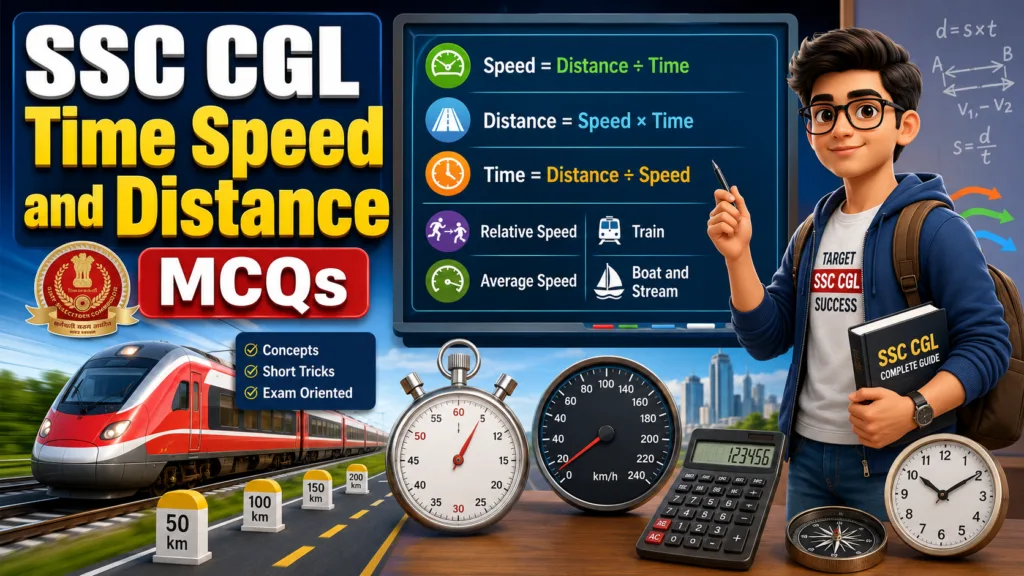
20 SSC CGL Time Speed & Distance MCQs : Powerful Practice

SSC CGL Time Speed & Distance MCQs with detailed solutions, shortcut tricks, trains, boats, relative speed practice questions.   SSC CGL Time Speed & Distance MCQs   1. A man travels from A to B at 60 km/h and returns from B to A at 40 km/h. What is his average speed for the entire journey? A. 48 km/h  B. 50 km/h C. 52 km/h   D. 45 km/h Correct Answer: A. 48 km/h Explanation:     2. A train 240 m long crosses a pole in 12 seconds. What is its speed? A. 60 km/h  B. 72 km/h C. 80 km/h  D. 90 km/h Correct Answer: B. 72 km/h Explanation: Distance covered = Length of train = 240 m Speed =  m/s = 20m/s Convert m/s into km/h: 20 × 18/5 km/h = 72km/h   3. A man increases his speed by 25%. By what percentage will the time taken for the same distance decrease? A. v15%  B. 20% C. 25%  D. 30% Correct Answer: B. 20% Explanation: Let original speed = 100 New speed = 125 T∝ 1/S​ New Time : Original Time = 100 : 125 = 4 :5 Decrease % =   × 100% = 20%   4. A car covers the first half of a journey at 40 km/h and the second half at 60 km/h. Find its average speed. A 45 km/h  B. 48 km/h C. 50 km/h  D. 52 km/h Correct Answer: B. 48 km/h Explanation:   SSC CGL Time Speed & Distance MCQs   5. A train 180 m long is running at 54 km/h. How much time will it take to cross a platform 270 m long? A. 20 sec  B. 25 sec C. 30 sec  D. 35 sec Correct Answer: C. 30 sec Explanation: Total distance covered = 180 + 270= 450 Convert speed: 54 × (5/18)=15 m/s Time: 45/15 = 30 sec     6. Two trains of lengths 150 m and 250 m are moving in opposite directions at 54 km/h and 72 km/h respectively. Find the time taken to cross each other. A. (80/7) sec  B. (90/7) sec C. (60/7) sec  D. (50/7) sec Correct Answer: A. (80/7) sec Explanation: Total length = 150 + 250 = 400 Relative speed =  54 + 72 = 126km/h ⟹ 126 × (5/18)=35 m/s Time = 400/35 sec= 80/7  sec   7. A person travels 120 km at 40 km/h and another 180 km at 60 km/h. Find his average speed. A. 45 km/h  B. 48 km/h C. 50 km/h  D. 52 km/h Correct Answer: C. 50 km/h Explanation: Total distance: 120 + 180 = 300 Time taken: 120/40h = 3 h 180/60= 3 h Total time = 6 h. Average Speed = 300/6 = 50 km/h   8. A train travelling at 90 km/h crosses a man standing on the platform in 8 seconds. Find the length of the train. A. 180 m  B. 200 m C. 220 m  D. 240 m Correct Answer: B. 200 m Explanation: Convert speed: 90 × (5/18 =25m/s Distance covered in 8 seconds: 25 × 8=200 m ∴ train length = 200 m.   9. A boat travels 30 km downstream in 2 hours and the same distance upstream in 3 hours. Find the speed of the boat in still water. A. 10 km/h  B. 12.5 km/h C. 15 km/h  D. 20 km/h Correct Answer: C. 12.5 km/h Explanation: Downstream speed: 30/2 =15 km/h Upstream speed = 30/3 =10 km/h Speed in still water:(15+10)/2=12.5 km/h     SSC CGL Time Speed & Distance MCQs   10. A man walks at 5 km/h and reaches his destination 12 minutes late. If he walks at 6 km/h, he reaches 8 minutes early. Find the distance. A. 8 km  B. 9 km C. 10 km  D. 12 km Correct Answer: C. 10 km Explanation: Difference in arrival time:12 + 8 = 20 min =1/3 hour Difference in time: D/5 – D/6=1/3 D(1/30) = 1/3 D = 10km   11. Two persons start from the same point and move in opposite directions at 6 km/h and 8 km/h. After how much time will they be 35 km apart? A. 2 hours  B. 2.5 hours C. 3 hours  D. 3.5 hours Correct Answer: B. 2.5 hours Explanation: Relative speed = 6 + 8 = 14 km/h Time = 35/1 = 2.5 hours   12. A man covers a certain distance at 12 km/h. If he had travelled at 15 km/h, he would have taken 20 minutes less. Find the distance. A. 15 km  B. 18 km C. 20 km  D. 24 km Correct Answer: C. 20 km Explanation: Time difference = 20 min= 1/3 hour[ D/12  –  D/15= 1/3 D(15 – 12 )/180= 1/3 D/60 =1/3 D = 20 km   13. A train crosses a 300 m platform in 20 seconds and a pole in 8 seconds. Find the length of the train. A. 180 m  B. 200 m C. 220 m  D. 240 m Correct Answer: B. 200 m Explanation: Let train length = (L) Speed when crossing pole: S = L/8 When crossing platform: S=(L+300)/20 L/8 =(L+300)/20 20L= 8L + 2400 12L = 2400[ L=200 m   14. A person travels from A to B at 30 km/h and returns at 20 km/h. If the total journey takes 5 hours, find the distance between A and B. A. 50 km  B. 55 km C. 60 km  D. 75 km Correct Answer: C. 60 km Explanation: Let one-way distance = (D). D/30+  D/20=5 LCM = 60: (2D+3D)/60 = 5 5D=300 D=60km SSC CGL Time Speed & Distance MCQs   15. Two trains of equal length are moving in the same direction at 72 km/h and 54 km/h. They take 20 seconds to overtake each other. Find the length of each train. A. 40 m  B. 45 m C. 50 m  D. 60 m Correct Answer: C. 50 m Explanation: Relative speed: 72 – 54=18 km/h 18 × (5/18)=5 m/s Total distance covered relative to each other: 5 × 20=100 m Since trains are equal: 2L=100 L=50 m   16. A man covers a distance in 7 hours. He covers one-third of the distance at 20 km/h

20 SSC CGL Time Speed & Distance MCQs : Powerful Practice Read More »

SSC CGL Mixture & Alligation MCQs

SSC CGL Mixture & Alligation MCQs: Master These Powerful Tricks

SSC CGL Mixture & Alligation MCQs with detailed solutions, shortcut tricks, and Tier II level questions to improve calculation speed, accuracy, and exam preparation.   SSC CGL Mixture & Alligation MCQs   1. A mixture contains milk and water in the ratio 7 : 3. If 20 liters of water is added to the mixture, the ratio becomes 7 : 5. What was the original quantity of the mixture?  A. 100 litres       B. 120 litres C. 140 litres         D. 160 litres Correct Answer:  A. 100 litres Explanation: Let the original quantities of milk and water be 7x and 3x. After adding 20 liters of water: 35x = 21x + 140  35x = 21x + 140 14x = 140    ⇒ x = 10  Original mixture:  7x+3x=10x        10 × 10 = 100     2. A vessel contains 60 liters of a mixture of milk and water in the ratio 2 : 1. How much water should be added to make the ratio 1 : 2? A. 45 litres       B. 50 litres C. 60 litres        D. 75 litres Correct Answer:  C. 60 litres Explanation: Milk = 60 × (2/3) = 40  Water = 20 litres. Let x litres of water be added.    80 = 20 + x x = 60    3. A 40-liter mixture contains milk and water in the ratio 3 : 1. How much mixture should be replaced by water so that the ratio becomes 1 : 1?  A. 13⅓ litres            B. 14⅓  litres C. 12⅓ litres             D. 23⅓  litres Correct Answer: A. 13⅓ litres Explanation: Initial milk = 30 litres, water = 10 litres. Suppose x litres of mixture are removed. Since the mixture is in the ratio 3 : 1: Milk removed = 3x/4 Water removed = x/4. Remaining milk = 30 – 3x/4 Remaining water 10 – x/4 After adding x litres of water:  10 – x/4 + x = 30 – 3x/4 10 + 3x/4  = 30 – 3x/4 20 = 3x/2  x = 40/3 = 13⅓ SSC CGL Mixture & Alligation MCQs 4. In what ratio should a 30% alcohol solution be mixed with a 70% alcohol solution to obtain a 50% alcohol solution? A. 1 : 1               B. 2 : 1 C. 1 : 2                D. 3 : 2 Correct Answer: A. 1 : 1 Explanation: Using alligation: 30%   70% Mean = 50%. Ratio: (70 – 50): (50 – 30) = 20 : 20 = 1:1   5. A merchant mixes rice costing ₹ 40 per kg with rice costing ₹ 60 per kg and sells the mixture at ₹ 66 per kg, making a profit of 20%. What is the ratio of cheaper rice to costlier rice? A. 1 : 3            B. 2 : 1 C. 3 : 2             D. 2 : 3 Correct Answer: A. 1 : 3 Explanation: Selling price = ₹ 66. Profit = 20%. Therefore, mixture cost price:  CP=      = 55   Mean = 55. Ratio: (60 – 55) : (55 – 40) = 5 : 15 = 1 : 3   6. A container has 80 litres of milk. 20 litres are removed and replaced with water. This process is repeated once more. How much milk remains? A. 40 litres     B. 45 litres C. 48 litres     D. 50 litres Correct Answer: C. 45 litres Explanation: The fraction retained each time is:    1 – 20/80 = 3/4 After two operations:   80 (3/4)2 =   80 (9/16)                       = 45   ∴ 45 litres of milk remain. SSC CGL Mixture & Alligation MCQs 7. A 60-litre mixture contains milk and water in the ratio 5 : 1. How much mixture must be removed and replaced with water to make the ratio 3 : 1? A.  6 litres         B. 10 litres C. 12 litres        D. 15 litres Correct Answer: A. 6 litres Explanation: Initial milk: 60 × 5/6 = 50 Let x litres of mixture be replaced. Milk removed:  (5/6)x Final milk: 50 – (5/6)x Final total mixture remains 60 litres. For a 3 : 1 ratio, milk should be: 60 × 3/4 = 45 Therefore: 50– (5/6)x = 45 (5/6) x = 5 x = 6 8. Two varieties of tea costing ₹240 per kg and ₹300 per kg are mixed with a third variety costing ₹360 per kg. If the quantities of the first and second varieties are equal and the average cost is₹300 per kg, what is the ratio of the quantity of the third variety to either of the first two? A. 1 : 1         B. 2 : 1 C. 1 : 2         D. 3 : 2 Correct Answer: A. 1 : 1 Explanation: Lthe quantitiesies of the first and second varieties be x each and the third be y.   = 300 540x + 360y = 600x + 300y 60y = 60x y = x y:x=1:1 SSC CGL Mixture & Alligation MCQs   9. A solution contains 25% acid. How much pure acid should be added to 80 litres of the solution to make the acid concentration 40%? A. 15 litres        B. 20 litres C. 25 litres       D. 30 litres Correct Answer: B. 20 litres Explanation: Initial acid: 80 × 25% = 20 Let x litres of pure acid be added.   = 40% 20 + x = 32 + 0.4x 0.6x =12 x = 20 SSC CGL Mixture & Alligation MCQs 10. A 50-litre mixture contains milk and water in the ratio 4 : 1. How much water must be added so that water becomes 30% of the final mixture? Corrected Options: A. 5 litres                 B. 7⅐ litres        C. 10 litres               D. 12½ litres Correct

SSC CGL Mixture & Alligation MCQs: Master These Powerful Tricks Read More »

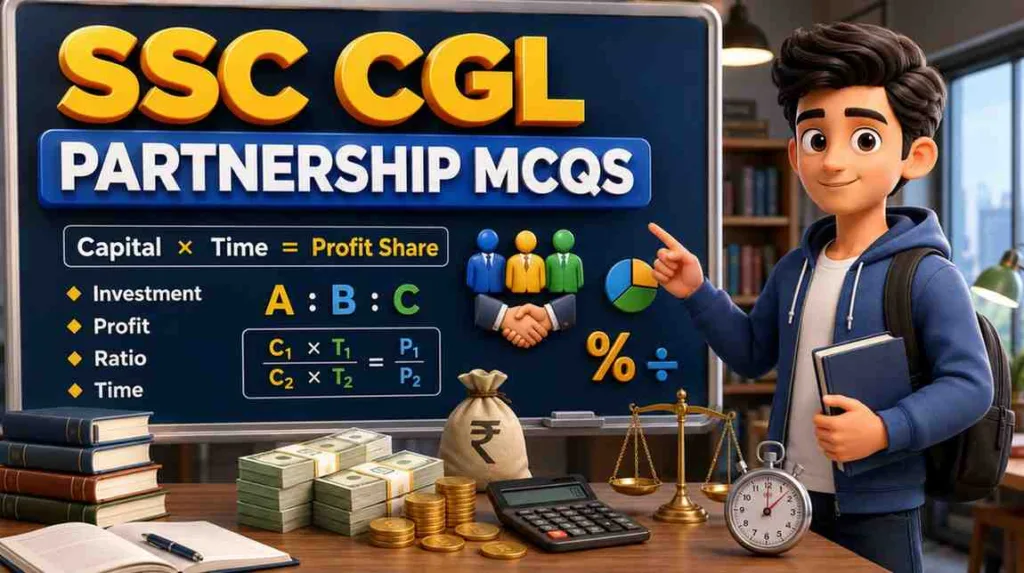
SSC CGL Partnership MCQs

20 SSC CGL Partnership MCQs:Master These Powerful Questions

SSC CGL Partnership MCQs with detailed solutions, shortcut tricks, and Tier-II-level questions. Practice capital-time ratios, profit sharing, changing investments, and advanced partnership problems. SSC CGL Partnership MCQs   1.  A and B start a business by investing ₹24,000 and ₹36,000, respectively. If A invests for 8 months and B invests for 6 months, what is the ratio of their profits? A. 8 : 9  B. 16 : 18   C. 8 : 9  D. 4 : 5 Correct Answer: A. 8 : 9 Explanation: Profit is proportional to capital × time A’s profit ratio = 24,000 × 8 = 192,000 B’s profit ratio = 36,000 × 6 = 216,000 ∴  A : B = 192,000 : 216,000 = 8 : 9   2. A and B invest in a business in the ratio 5 : 7. A invests for 12 months, and B invests for 10 months. If B’s share of profit is ₹4,200, what is A’s share? A. ₹ 3,000       B. ₹ 3,200 C. ₹ 3,600        D. ₹ 4,000 Correct Answer: C. ₹ 3,600 Explanation: Profit ratio = Capital × Time A : B = 5 × 12 : 7 × 10 = 60 : 70 = 6 : 7 B gets ₹4,200 for 7 parts. A’s share = 4,200 × 6/7 = ₹3,600   3. A invests ₹50,000 for 6 months, B invests ₹40,000 for 9 months, and C invests ₹60,000 for 5 months. Find their profit-sharing ratio. A. 5 : 6 : 5        B. 5 : 6 : 4   C. 10 : 12 : 10  D. 25 : 36 : 30 Correct Answer: A. 5 : 6 : 5 Explanation: Profit ratio = Capital × Time A = 50,000 × 6 = 300,000 B = 40,000 × 9 = 360,000 C = 60,000 × 5 = 300,000 Ratio = 300 : 360 : 300 = 5 : 6 : 5   4. A starts a business with ₹40,000. After 4 months, B joins with ₹60,000. At the end of the year, the total profit is ₹18,000. Find B’s share. A. ₹ 8,000  B. ₹ 9,000 C. ₹10,000  D. ₹ 12,000 Correct Answer: C. ₹ 10,000 Explanation: A invests for 12 months. A’s investment-time = 40,000 × 12 = 480,000 B joins after 4 months, so B invests for 8 months: B’s investment-time = 60,000 × 8 = 480,000 Profit ratio = 1 : 1 B’s share = 18,000 ÷ 2 = ₹9,000 Therefore, the correct answer is actually B, ₹9,000. Profits are equal.   5. A and B start a business with investments of ₹30,000 and ₹40,000, respectively. A remains in the business for 12 months, while B leaves after 9 months. If the total profit is ₹11,700, find A’s share. A. ₹ 5,400  B. ₹ 6,000   C. ₹ 5,850  D. ₹ 7,200 Correct Answer: C. ₹ 5,850 Explanation: A’s capital-time = 30,000 × 12 = 360,000 B’s capital-time = 40,000 × 9 = 360,000 Profit ratio = 1 : 1. Thus, A’s share = ₹11,700 ÷ 2 = ₹5,850. ∴ none of the given options is correct. SSC CGL Partnership MCQs 6. A, B, and C invest ₹20,000, ₹30,000, and ₹40,000, respectively, for 12, 8, and 6 months. If A receives ₹4,000 as profit, find the total profit. A. ₹ 10,000  B. ₹ 12,000 C. ₹ 15,000  D. ₹ 18,000 Correct Answer: B. ₹ 12,000 Explanation: A = 20,000 × 12 = 240,000 B = 30,000 × 8 = 240,000 C = 40,000 × 6 = 240,000 Therefore, profit ratio = 1 : 1 : 1. A receives ₹4,000, so total profit = 4,000 × 3 = ₹ 12,000.   7. A and B invest ₹60,000 and ₹90,000, respectively. A manages the business and receives 20% of the total profit as salary. The remaining profit is divided according to their investments. If the total profit is ₹30,000, find A’s total earnings. A. ₹ 14,500  B. ₹ 15,600 C. ₹ 13,600  D. ₹ 16,000 Correct Answer: B. ₹ 15,600 Explanation: A’s salary = 20% of ₹30,000 = ₹6,000. Remaining profit = ₹30,000 − ₹6,000 = ₹24,000. Investment ratio = 60,000 : 90,000 = 2 : 3. A’s share = 24,000 × 2/5 = ₹9,600. A’s total earnings = 9,600 + 6,000 = ₹15,600.   8. A invests ₹50,000 for the first 6 months and increases his investment to ₹80,000 for the remaining 6 months. B invests ₹70,000 throughout the year. Find the ratio of their profits. A. 10 : 11  B. 11 : 14   C. 13 : 14  D. 14 : 13 Correct Answer: C. 13 : 14 Explanation: A’s effective investment: 50,000 × 6 + 80,000 × 6 = 300,000 + 480,000 = 780,000 B’s effective investment: 70,000 × 12 = 840,000 Profit ratio = 780 : 840 = 13 : 14   9. A invests ₹80,000 initially and withdraws ₹20,000 after 6 months. B invests ₹60,000 throughout the year. Find the ratio of their profits. A. 11 : 12  B. 14 : 15   C. 7 : 6   D. 13 : 12 Correct Answer: B. 7 : 6 Explanation: A invests ₹80,000 for 6 months and ₹60,000 for the next 6 months. A’s capital-time = 80 × 6 + 60 × 6 = 840 B’s capital-time = 60 × 12 = 720 Ratio = 840 : 720 = 7 : 6 ∴, none of the options is correct. SSC CGL Partnership MCQs   10. A and B share profit in the ratio 7 : 9. A invests ₹28,000 for 9 months. If B invests for 7 months, find B’s investment. A. ₹ 45,285.71          B. ₹ 46,275.81    C. ₹ 44,285.71   D. ₹ 46,285.71  Correct Answer: D. ₹46,285.71 Explanation: Profit ratio: 28,000 × 9 : B × 7 = 7 : 9 28 × 9 / (7B) = 7/9 B = (28 × 9 × 9)/(7 × 7)—this does not yield ₹42,000. 28,000 × 9 / (B × 7) = 7/9 252,000 × 9 = 7 × 7B 2,268,000 = 49B B = ₹ 46,285.71    11.  A, B, and C invest in the

20 SSC CGL Partnership MCQs:Master These Powerful Questions Read More »

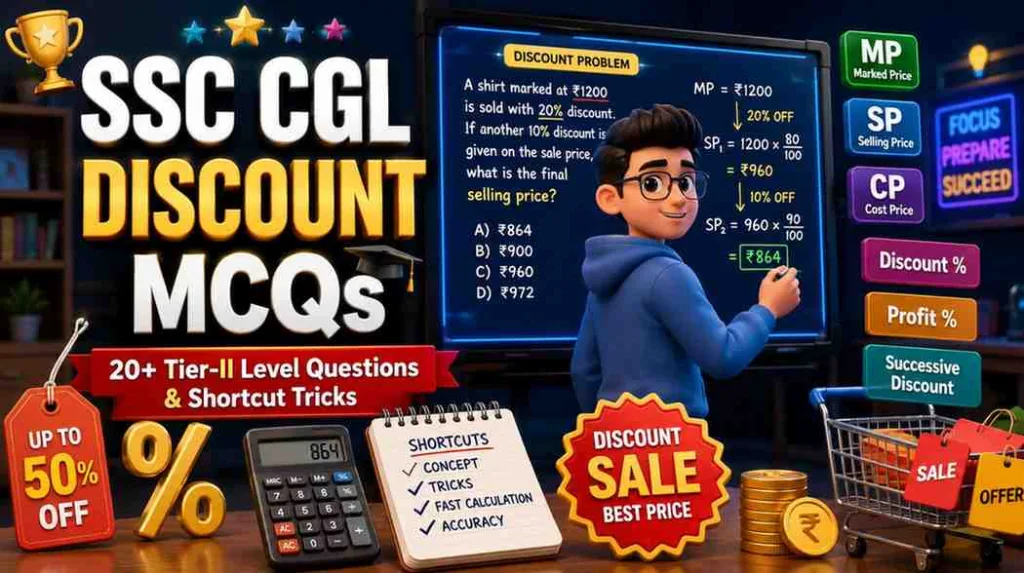
SSC CGL Discount MCQs

20 SSC CGL Discount MCQs: Master Tricks & Ace the Exam

Practice 20+ high-quality SSC CGL Discount MCQs with detailed solutions, shortcut tricks, and Tier-II level questions to improve speed, accuracy, and exam performance. SSC CGL Discount MCQs   1. A shopkeeper marks an article 40% above its cost price and allows a discount of 10% on the marked price. What is his profit percentage? A.24%  B. 26% C. 28%  D. 30% Correct Answer: A. 26% Explanation: Let CP = ₹100. Marked Price = 100 + 40% of 100 = ₹140. Selling Price = 90% of ₹140 = ₹126. Profit = 126 − 100 = ₹26. Profit% = 26%. 2. An article marked at ₹2,500 is sold after successive discounts of 20% and 10%. Find the selling price. A. ₹1,750  B. ₹1,800 C. ₹1,850  D. ₹1,900 Correct Answer: B. ₹1,800 Explanation: First discount = 20% so price becomes 80% Second discount = 10% so price becomes 90% SP = 2500 × 80/100 × 90/100 = ₹1,800.   3. Two successive discounts of 15% and 20% are equivalent to a single discount of: A.32%  B. 33% C. 35%  D. 38% Correct Answer: B. 32% Explanation: Equivalent discount = a + b − ab/100 = 15 + 20 − (15 × 20)/100 = 35 − 3 = 32%.   4. A trader allows a discount of 12% on the marked price and still earns a profit of 10%. If the cost price is ₹1,000, find the marked price. A. ₹1,200  B. ₹1,225 C. ₹1,250  D. ₹1,275 Correct Answer: C. ₹1,250 Explanation: CP = ₹1,000. Profit = 10%. SP = 110% of 1000 = ₹1,100. A 12% discount means SP = 88% of MP. 88% of MP = 1100 MP = 1100 × 100/88 = ₹1,250.   5. A shopkeeper gives a discount of 25% on the marked price and suffers a loss of 10%. If the cost price is ₹2,400, find the marked price. A. ₹2,880  B. ₹3,000 C. ₹3,120  D. ₹3,200 Correct Answer: A. ₹2,880 Explanation: SP = 90% of CP = 90% × 2400 = ₹2,160. Since  25% discount is given, SP = 75% of MP. MP = 2160 × 100/75 = ₹2,880. 6. An article is sold for ₹1,530 after allowing a discount of 15%. What is its marked price? A. ₹1,700  B. ₹1,750 C. ₹1,800  D. ₹1,850 Correct Answer: A. ₹1,800 Explanation: SP = 85% of MP. MP = 1530 × 100/85 = ₹1,800. SSC CGL Discount MCQs   7. A shopkeeper offers a discount of 20% and then an additional discount of 15%. What single discount is equivalent to these two discounts? A. 32%  B. 35% C. 37%  D. 38% Correct Answer: A. 32% Explanation: Equivalent discount  = 20 + 15 − (20 × 15)/100 = 35 − 3 = 32%. SSC CGL Discount MCQs     8. A shopkeeper marks an article 50% above its cost price and gives a discount of 20%. Find his profit percentage. A. 15%  B. 20% C. 25%  D. 30% Correct Answer: B. 20% Explanation: Let CP = ₹100. MP = ₹150. SP = 80% of ₹150 = ₹120. Profit = ₹20. Profit% = 20%. 9. An article is marked 60% above its cost price. What discount should be allowed to earn a profit of 20%? A. 20%  B. 22.5% C. 25%  D. 30% Correct Answer: C. 25% Explanation: Let CP = ₹100. MP = ₹160. Required SP = ₹120. Discount = 160 − 120 = ₹40. Discount% = 40/160 × 100 = 25%.   10. A retailer buys an article for ₹800 and marks it at ₹1,200. If he gives a discount of 15%, what is his profit percentage? A. 20%   B. 25% C. 27.5%  D. 30% Correct Answer: B. 27.5% Explanation: SP = 85% of 1200 = ₹1,020. Profit = 1020 − 800 = ₹220. Profit% = 220/800 × 100 = 27.5%.   11. A product is sold at a discount of 25% on its marked price. If the seller earns 20% profit, then the ratio of marked price to cost price is: A. 4 : 3  B. 5 : 4 C. 8 : 5  D. 6 : 5 Correct Answer: C. 8 : 5 Explanation: SP = 75% of MP. SP = 120% of CP. Therefore, 75 MP/100 = 120 CP/100 MP/CP = 120/75 = 8/5. Hence, MP : CP = 8 : 5. SSC CGL Discount MCQs 12. A shopkeeper gives two successive discounts of 10%, x% and the total equivalent discount is 28%. Find x. A. 18%  B. 20% C. 22%  D. 25% Correct Answer: B. 20% Explanation: 10 + x − 10x/100 = 28 10 + x − x/10 = 28 9x/10 = 18 x = 20%. 13. An article marked at ₹4,000 is sold at a discount of 12.5%. Find the selling price. A. ₹3,400  B. ₹3,450 C. ₹3,500  D. ₹3,600 Correct Answer: C. ₹3,500 Explanation: 12.5% = 1/8. Discount = 4000/8 = ₹500. SP = 4000 − 500 = ₹3,500.   14. A shopkeeper allows a discount of 16% on the marked price. If the marked price is ₹2,500, how much does the customer save? A. ₹350  B. ₹375 C. ₹400  D. ₹425 Correct Answer: C. ₹400 Explanation: Discount = 16% of ₹2,500. = 16/100 × 2500 = ₹400.   15. A shopkeeper wants to earn 25% profit after giving a discount of 20%. By what percentage should he mark the article above its cost price? A. 50%  B. 52.5% C. 56.25%  D. 60% Correct Answer: C. 56.25% Explanation: Let CP = ₹100. Required SP = ₹125. Since SP = 80% of MP, MP = 125 × 100/80 = ₹156.25. Markup = 156.25 − 100 = ₹56.25. Therefore, markup = 56.25%.   16. A seller gives a discount of 10% on an article and earns a profit of 17%. If the cost price is ₹1,500, find the marked price. A. ₹1,900  B. ₹1,950 C. ₹2,000  D. ₹2,050 Correct Answer: C. ₹1,950 Explanation: SP = 117% of 1500 = ₹1,755. Since SP = 90% of MP, MP = 1755 × 100/90 = ₹1,950. SSC CGL Discount MCQs   17. A trader marks his goods 80% above cost price and offers a discount of 25%. What is his profit percentage? A. 30%  B. 35% C. 40%  D. 45%

20 SSC CGL Discount MCQs: Master Tricks & Ace the Exam Read More »

SSC CGL Interest MCQs

20 Powerful SSC CGL Interest MCQs with Solutions

20 Powerful SSC CGL Interest MCQs with Solutions Practice SSC CGL Interest MCQs with detailed solutions, shortcut tricks, and Tier-II-level questions on Simple Interest and Compound Interest. Improve speed and accuracy for SSC CGL 2026. 1. A sum amounts to ₹6,600 in 2 years at 10% per annum Simple Interest. What is the principal? A. ₹5,000  B. ₹5,500 C. ₹6,000  D. ₹4,800 Correct Answer: B. ₹5,500 Explanation: Amount = Principal + SI SI = P × 10 × 2 /100 = 0.2P Amount = 1.2P 1.2P = 6600 P = 6600/1.2 = ₹5,500? Wait: Actually, SI = P×10×2/100 = 20% of P If P=5500 SI=1100 Amount=6600 Hence Principal = ₹5,500 2. The Simple Interest on ₹8,000 at 12% per annum for 5 years is A. ₹4,600  B. ₹4,800 C. ₹5,000  D. ₹5,200 Correct Answer: B. ₹4,800 Explanation: SI=(8000×12×5)/100       =₹4,800 3. At what rate will ₹2,500 earn ₹750 as Simple Interest in 6 years? A. 4%  B. 5% C. 6%  D. 7% Correct Answer: B. 5% Explanation: R = (SI×100)/(P×T)     = (750×100)/(2500×6)      = 5% 4. A sum becomes ₹15,000 in 4 years at 25% Simple Interest. Find the principal. A. ₹7,500  B. ₹8,000 C. ₹9,000  D. ₹10,000** Correct Answer: A. ₹7,500 Explanation: Interest = 25×4=100% Amount = 200% of Principal Principal = 15000÷2                    = ₹7,500 5. Simple Interest on a certain sum for 8 years is equal to the principal. Find the rate. A.10%  B.11% C.12.5%  D.15% Correct Answer: C. 12.5% Explanation: SI=P P×R×8/100 = P R=100/8 =12.5% SSC CGL Interest MCQs 6. The Compound Interest on ₹10,000 at 10% per annum for 2 years is A. ₹2,000  B. ₹2,100 C. ₹2,200  D. ₹2,300 Correct Answer: B. ₹2,100 Explanation Amount =10000×1.1²                 =12100 CI=12100−10000      =₹2,100 7. A sum becomes ₹9,680 in 2 years at 10% Compound Interest. Find the principal. A. ₹7,800  B. ₹8,000 C. ₹8,200  D. ₹8,400 Correct Answer: B. ₹8,000 Explanation P = 9680/1.21     =₹8,000 8. The difference between Compound Interest and Simple Interest on ₹5,000 for 2 years at 20% per annum is A. ₹100  B. ₹150 C. ₹200  D. ₹250 Correct Answer: C. ₹200 Explanation: Difference =P(R²)/10000                     =5000×400/10000                     =₹200 9. A sum doubles itself in 10 years at Simple Interest. In how many years will it become three times? A.15  B.18 C.20  D.25 Correct Answer: C. 20 Explanation: Doubling means Interest=100% in 10 years Rate=10% For triple amount, Interest=200% Time=20 years SSC CGL Interest MCQs 10. The Compound Interest on ₹20,000 at 5% per annum for 3 years is A. ₹3,050  B. ₹3,100 C. ₹3,152.50  D. ₹3,250 Correct Answer: C. ₹3,152.50 Explanation: Amount =20000×1.05³                  =20000×1.157625                  =23152.50 CI =23152.50−20000       =₹3,152.50 11. A sum of money amounts to ₹13,200 in 3 years at 10% per annum Compound Interest (compounded annually). Find the principal. A. ₹9,000  B. ₹9,500 C. ₹10,000  D. ₹10,500 Correct Answer: C. ₹10,000 Explanation: Amount = P(1 + R/100)³ 13200 = P × (1.1)³ 13200 = P × 1.331 P = 13200 ÷ 1.331      = ₹10,000 12. The Simple Interest on a sum for 4 years at 15% per annum is ₹2,400. Find the principal. A. ₹3,500  B. ₹4,000 C. ₹4,500  D. ₹5,000 Correct Answer: B. ₹4,000 Explanation: SI = (P × R × T)/100 2400 = P ×15×4/100 2400 = 0.6P P = ₹4,000 Shortcut Trick 15% ×4 = 60% Principal = SI ÷60% = 2400÷0.6 = 4000 13. At what annual rate will ₹8,000 become ₹10,400 in 3 years at Simple Interest? A. 8%  B. 9% C. 10%  D. 12% Correct Answer: C. 10% Explanation: SI =10400−8000      =2400 Rate  = (2400×100)/(8000×3)          =10% 14. A sum invested at 8% Compound Interest becomes ₹11,664 in 2 years. Find the principal. A. ₹9,800  B. ₹10,000 C. ₹10,200  D. ₹10,500 Correct Answer: B. ₹10,000 Explanation: Amount=P×1.08²                 =1.1664P P=11664÷1.1664     =₹10,000 15. Find the difference between Compound Interest and Simple Interest on ₹12,000 for 2 years at 15% per annum. A. ₹250  B. ₹260 C. ₹270  D. ₹280 Correct Answer: C. ₹270 Explanation: Difference =P × R²/10000                      =12000 × 225/10000                       = ₹270 16. A sum becomes ₹18,000 in 5 years at 20% Simple Interest. Find the interest earned. A. ₹8,000  B. ₹9,000 C. ₹10,000  D. ₹11,000 Correct Answer: B. ₹9,000 Explanation: 20% ×5 =100% Interest = Principal Amount =2P Principal =18000÷2 =9000 Interest =₹9000 Shortcut Trick 100% interest ⇒ Amount doubles. 17. A person borrows ₹25,000 at 12% per annum Simple Interest for 18 months. Find the interest. A. ₹4,000  B. ₹4,200 C. ₹4,500  D. ₹4,800 Correct Answer: C. ₹4,500 Explanation: 18 months =1.5 years SI=(25000×12×1.5)/100     =₹4,500   18. If the Compound Interest on a sum for 2 years at 10% is ₹2,310, find the principal. A. ₹9,000  B. ₹10,000 C. ₹11,000  D. ₹12,000 Correct Answer: C. ₹11,000 Explanation: For 2 years at 10% CI =21% of Principal Principal=2310÷0.21                  =₹11,000 19. A sum invested at 10% Compound Interest becomes ₹14,641 in 4 years. Find the principal. A. ₹9,500  B. ₹10,000 C. ₹10,500  D. ₹11,000 Correct Answer: B. ₹10,000 Explanation: (1.1)⁴=1.4641 Principal =14641÷1.4641                   =₹10,000 SSC CGL Interest MCQs 20. The Simple Interest on a sum for 6 years at 8% per annum is ₹3,840. Find the amount. A. ₹10,000  B. ₹11,840 C. ₹12,000  D. ₹12,800 Correct Answer: B. ₹11,840 Explanation SI=(P×8×6)/100 3840=0.48P P=3840÷0.48   =₹8,000 Amount =8000+3840                 =₹11,840         SSC CGL Quantitative Aptitude Topics Number System Decimals Fractions Percentages Ratio & proportion Square roots Averages Interest (simple & compound) Profit & loss Discount Partnerships Mixture & Alligation Time & speed & distance Time & work Advanced math includes basic algebraic identities Elementary surds Linear equations Triangles Circles Regular polygons, right prisms, cones, cylinders, spheres Trigonometry YOUTUBE   If you are interested in reading stories, CLICK HERE

20 Powerful SSC CGL Interest MCQs with Solutions Read More »

SSC CGL Profit and Loss MCQs

Top 20 SSC CGL Profit and Loss MCQs – Powerful Practice 2026

Top 20 SSC CGL Profit and Loss MCQs – Powerful Practice 2026   Practice SSC CGL Profit and Loss MCQs with detailed solutions, shortcut tricks, and Tier-II level questions. Improve speed, accuracy, and exam confidence with the latest SSC CGL pattern.   SSC CGL Maths Profit & Loss MCQs   1. A shopkeeper marks an article 40% above the cost price and allows a discount of 10%. If the selling price is ₹630, what is the cost price? A. ₹450  B. ₹500 C. ₹520   D. ₹550 Correct Answer: B. ₹500 Explanation: Let the cost price = ₹x. Marked Price = 140% of CP = 1.4x Selling Price = 90% of MP = 1.4x × 0.9 = 1.26x 1.26x = 630 x = 630 ÷ 1.26 = ₹500 2. A trader gains 20% by selling an article. If the cost price increases by 25% and the selling price remains unchanged, what will be the new profit/loss percentage? A. 4% Loss B. 4% Profit C. 8% Loss D. No Profit No Loss Correct Answer:  A. 4% Loss Explanation: Assume CP = ₹100 SP = ₹120 New CP = ₹125 Loss = 125 − 120 = ₹5 Loss% = (5/125) ×100 = 4% 3. A shopkeeper gives successive discounts of 20% and 10%. Find the single equivalent discount. A. 28% B. 30% C. 26% D. 32% Correct Answer: A. 28% Explanation: Equivalent Discount = 20 +10 − (20×10)/100 =30−2 =   28% 4. A man sold an article for ₹960 at a loss of 20%. At what price should he sell it to gain 20%? A. ₹1280 B. ₹1360 C. ₹1440 D. ₹1500  Correct Answer:     C. ₹1440   Explanation:  Loss 20% SP = 80% CP = 960×100/80      = ₹1200 Required SP =120% of 1200                  =₹1440 5. A shopkeeper uses a false weight of 900 g instead of 1 kg and sells goods at cost price. His profit percentage is A. 10%   B. 11.11% C. 9%   D. 12.5% Correct Answer:     B. 11.11% Explanation:  He charges for 1000 g but gives only 900 g. Profit = (100/900)×100             =11.11% 6. An article is sold for ₹540 after allowing a discount of 25%. If the shopkeeper gains 20%, what is the marked price? A. ₹700   B. ₹720 C. ₹760   D. ₹800 Correct Answer:     B. ₹720 Explanation:  SP = ₹540 Discount =25% MP =540×100/75 =₹720 Checking: CP=540/1.2=450 Gain=20% MP after 25% discount = 720 × 75% = 540 7. A trader sells two articles for ₹600 each. On one he gains 20%, and on the other he loses 20%. Overall, he A. Gains 2%   B. Loses 4% C. Loses 4.17%   D. No Profit No Loss Correct Answer:     B. Loses 4% Explanation:  CP₁ =600/1.2=500 CP₂ =600/0.8=750 Total CP=1250 Total SP=1200 Loss = 50 Loss% = (50/1250) × 100 = 4%   SSC CGL Maths Profit & Loss MCQs   8. A trader marks his goods 60% above cost price and allows a discount of 25%. His profit percentage is A. 18%   B. 20% C.25%   D. 30% Correct Answer:     B. 20% Explanation:  Take CP=100 MP=160 SP=160×75% =120 Profit=20% SSC CGL Maths Profit & Loss MCQs   9. The ratio of cost price to selling price is 25 : 28. Find the profit percentage. A. 10%   B. 12% C. 15%   D. 18% Correct Answer:     B. 12% Explanation:  Profit = 28 −25 = 3 Profit% = (3/25)×100 %             = 12%     SSC CGL Maths Profit & Loss MCQs 10. A trader allows a discount of 20% on the marked price and still earns a profit of 12%. By what per cent is the marked price above the cost price? A. 35%    B. 38% C. 40%    D. 42%  Correct Answer:     C. 40%  Explanation:  Assume CP =100 Profit 12% SP =  112 After 20% discount, SP = 80% of MP MP = 112×100/80 =140 Mark-up = (140 −100) = 40% 11. A trader marks an article 50% above its cost price and allows two successive discounts of 10% and 20%. What is his profit percentage? A. 5%   B. 8% C. 10%   D. 12% Correct Answer:     B. 8% Explanation:  Assume Cost Price (CP) = ₹100 Marked Price (MP) = ₹150 After 10% discount = ₹150 × 90% = ₹135 After 20% discount = ₹135 × 80% = ₹108 Profit = ₹108 − ₹100 = ₹8 Profit % =   8% SSC CGL Maths Profit & Loss MCQs   12. A shopkeeper earns a profit of 25% after giving a discount of 20% on the marked price. By what percentage is the marked price above the cost price? A. 50%   B. 56.25% C. 60%   D. 62.5% Correct Answer:     B. 56.25% Explanation:  Assume CP = ₹100 SP = ₹125 (25% profit) SP = 80% of MP MP = 125 × 100 / 80 = ₹156.25 Mark-up = 156.25 − 100 =   56.25% 13. An article is sold at a gain of 15%. Had it been sold for ₹92 more, the gain would have been 23%. The cost price is: A. ₹1,100   B. ₹1,150 C. ₹1,200   D. ₹1,250 Correct Answer:     B. ₹1,150 Explanation:  Difference in profit = 23% − 15%                               = 8% 8% of CP = ₹92 CP = 92 × 100 / 8       =   ₹1,150 SSC CGL Maths Profit & Loss MCQs 14. A trader purchases an article for ₹800 and spends ₹120 on transportation. If he wants a profit of 25%, at what price should he sell it? A. ₹1,100   B. ₹1,150 C. ₹1,180   D. ₹1,200 Correct Answer:     B. ₹1,150 Explanation:  Total Cost = 800 + 120                 = ₹920 Required SP = 920 × 125%                    =   ₹1,150 SSC CGL Profit and Loss MCQs 15. A trader sells sugar at

Top 20 SSC CGL Profit and Loss MCQs – Powerful Practice 2026 Read More »

Scroll to Top