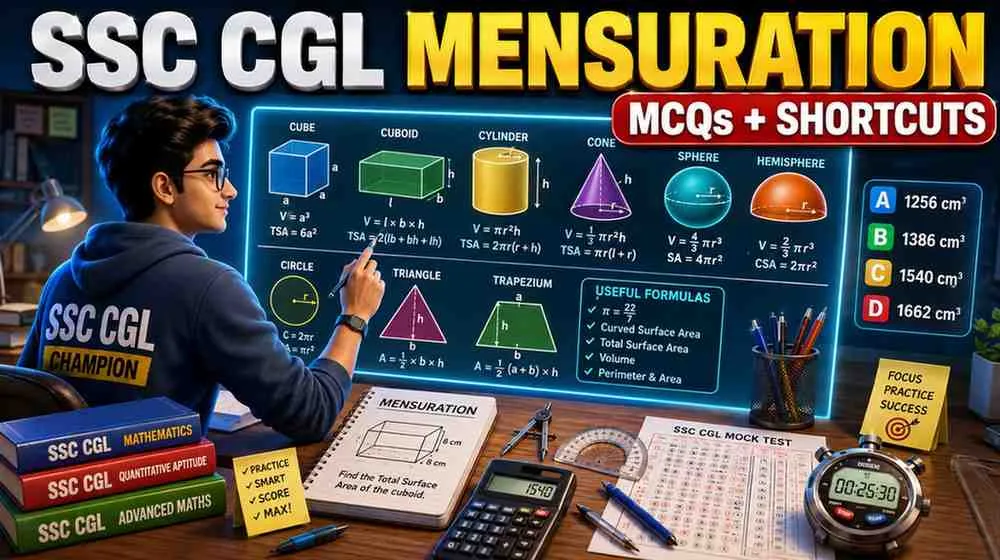
SSC CGL Mensuration MCQs with exam-oriented answers, detailed explanations, shortcut tricks, and Tier-I & Tier-II level practice for SSC CGL Maths preparation.
SSC CGL Mensuration MCQs
1. The length and breadth of a rectangle are in the ratio 5 : 3. If its area is 540 cm², what is its perimeter?
A) 96 cm B) 104 cm
C) 108 cm D) 112 cm
Correct Answer: A) 96 cm
Explanation:
Let length = 5x and breadth = 3x
Area = 5x × 3x = 15x²
15x² = 540
x² = 36
x = 6
Therefore,
Length = 30 cm
Breadth = 18 cm
Perimeter = 2(l + b)
= 2(30 + 18)
= 96 cm
2. The diagonal of a square is 14√2 cm. What is its area?
A) 98 cm² B) 196 cm²
C) 392 cm² D) 49 cm²
Correct Answer: B) 196 cm²
Explanation:
For a square
Diagonal = side × √2
Side = 14√2 / √2 = 14 cm
Area = side² = 14² = 196 cm²
Shortcut: Area of square = d²/2
= (14√2)² / 2
= 392/2
= 196 cm²
3. The base of a triangle is 24 cm, and its corresponding height is 15 cm. Find its area.
A) 160 cm² B) 180 cm²
C) 360 cm² D) 190 cm²
Correct Answer: B) 180 cm²
Explanation:
Area of triangle = ½ × base × height
= ½ × 24 × 15
= 12 × 15
= 180 cm²
4. The parallel sides of a trapezium are 18 cm and 32 cm, and its height is 14 cm. Find its area.
A) 320 cm² B) 350 cm²
C) 375 cm² D) 400 cm²
Correct Answer: B) 350 cm²
Explanation:
Area of trapezium
= ½ × (sum of parallel sides) × height
= ½ × (18 + 32) × 14
= ½ × 50 × 14
= 350 cm²
5. The area of a parallelogram is 420 cm². If its base is 28 cm, find the corresponding height.
A) 12 cm B) 15 cm
C) 18 cm D) 20 cm
Correct Answer: B) 15 cm
Explanation:
Area = base × height
420 = 28 × h
h = 420/28 = 15 cm
SSC CGL Mensuration MCQs
6. The diagonals of a rhombus are 24 cm and 10 cm. Find its area.
A) 100 cm² B) 120 cm²
C) 240 cm² D) 60 cm²
Correct Answer: B) 120 cm²
Explanation:
Area of rhombus = 1/2 × d₁ × d₂
= 1/2 × 24 × 10
= 120 cm²
= 2 × 22/7 × 14
= 88 cm
7. A cylinder has a radius of 7 cm and a height of 10 cm. Find its volume.
A) 1540 cm³ B) 770 cm³
C) 3080 cm³ D) 980 cm³
Correct Answer: A) 1540 cm³
Explanation:
Volume = πr²h
= 22/7 × 7² × 10
= 22 × 7 × 10
= 1540 cm³
8. The radius of a cylinder is 7 cm, and its height is 15 cm. Find its curved surface area.
A) 440 cm² B) 660 cm²
C) 770 cm² D) 880 cm²
Correct Answer: B) 660 cm²
Explanation:
CSA = 2πrh
= 2 × 22/7 × 7 × 15
= 44 × 15
= 660 cm²
9. Find the volume of a cone having radius 6 cm and height 7 cm.
A) 132 cm³ B) 264 cm³
C) 396 cm³ D) 792 cm³
Correct Answer: B) 264 cm³
Explanation:
Volume of cone = 1/3πr²h
= 1/3 × 22/7 × 36 × 7
= 22 × 12
= 264 cm³
SSC CGL Mensuration MCQs
10. A cone has a radius of 12 cm and a height of 5 cm. What is its slant height?
A) 13 cm B) 17 cm
C) 10 cm D) 7 cm
Correct Answer: A) 13 cm
Explanation:
For a cone
l² = r² + h²
= 12² + 5²
= 144 + 25
= 169
l = 13 cm
SSC CGL Mensuration MCQs
11. Find the volume of a sphere of radius 3 cm.
A) 36π cm³ B) 27π cm³
C) 18π cm³ D) 9π cm³
Correct Answer: A) 36π cm³
Explanation:
Volume of sphere = 4/3πr³
= 4/3 × π × 3³
= 4/3 × π × 27
= 36π cm³
12. Find the total surface area of a hemisphere of radius 7 cm.
A) 154 cm² B) 308 cm²
C) 462 cm² D) 616 cm²
Correct Answer: C) 462 cm²
Explanation:
TSA of hemisphere = 3πr²
= 3 × 22/7 × 49
= 462 cm²
13. The total surface area of a cube is 864 cm². Find its volume.
A) 1728 cm³ B) 1296 cm³
C) 864 cm³ D) 216 cm³
Correct Answer: A) 1728 cm³
Explanation:
TSA = 6a²
6a² = 864
a² = 144
a = 12 cm
Volume = a³
= 12³
= 1728 cm³
14. A cuboid has dimensions 12 cm, 9 cm, and 20 cm. Find its diagonal.
A) 23 cm B) 25 cm
C) 29 cm D) 31 cm
Correct Answer: B) 25 cm
Explanation:
Diagonal:
d = √(l² + b² + h²)
= √(12² + 9² + 20²)
= √(144 + 81 + 400)
= √625
= 25 cm
15. A cube is painted on all its faces and then divided into 125 equal smaller cubes. How many smaller cubes have exactly two faces painted?
A) 24 B) 36
C) 48 D) 60
Correct Answer: C) 36
Explanation:
125 = 5³
So the large cube is divided into 5 × 5 × 5 cubes.
Cubes having exactly two faces painted lie along the edges, excluding the corner cubes.
Number = 12(n − 2)
= 12(5 − 2)
= 36
16 A rectangular garden is 40 m long and 30 m wide. A path of width 2 m is constructed outside the garden. Find the area of the path.
A) 296 m² B) 300 m²
C) 304 m² D) 320 m²
Correct Answer: A) 296 m².
Explanation:
Outer length = 40 + 4 = 44 m
Outer breadth = 30 + 4 = 34 m
Outer area = 44 × 34 = 1496 m²
Garden area = 40 × 30 = 1200 m²
Area of path = 1496 − 1200
= 296 m²
SSC CGL Mensuration MCQs
17. A circular park has a radius of 21 m. A path of width 7 m is constructed inside the park. Find the area of the path. Take π = 22/7.
A) 924 m² B) 770 m²
C) 1078 m² D) 1155 m²
Correct Answer: B) 770 m²
Explanation:
Outer radius = 21 m
Inner radius = 21 − 7 = 14 m
Area of path = π(R² − r²)
= 22/7 × (441 − 196)
= 22/7 × 245
= 770 m²
18. A room is 8 m long and 6 m wide. It is to be covered with square tiles of side 40 cm. How many tiles are required?
A) 250 B) 300
C) 350 D) 400
Correct Answer: B) 300
Explanation:
Room area = 8 × 6 = 48 m²
Tile side = 40 cm = 0.4 m
Tile area = 0.4 × 0.4 = 0.16 m²
Number of tiles = 48/0.16
= 300
19. A cylindrical tank has a radius of 3.5 m and a height of 4 m. Find its capacity in liters.
Take π = 22/7.
A) 154,000 L B) 140,000 L
C) 110,000 L D) 77,000 L
Correct Answer: A) 154,000 L
Explanation:
Volume = πr²h
= 22/7 × 3.5 × 3.5 × 4
= 154 m³
Since 1 m³ = 1000 liters
Capacity = 154 × 1000
= 154,000 liters
20. The radii of the two circular ends of a frustum are 7 cm and 3.5 cm, and its height is 12 cm. Find its volume.
A) 770 cm³ B) 924 cm³
C) 1078 cm³ D) 1155 cm³
Correct Answer: C) 1078 cm³.
Explanation:
Volume of frustum
V = 1/3πh(R² + r² + Rr)
R = 7, r = 3.5, h = 12
V = 1/3 × 22/7 × 12 × (49 + 12.25 + 24.5)
= 1/3 × 22/7 × 12 × 85.75
= 1078 cm³
SSC CGL Mensuration MCQs
21. A solid consists of a cylinder of radius 7 cm and height 10 cm surmounted by a hemisphere of the same radius. Find its volume.
A) 1796⅔ cm³ B) 2000 cm³
C) 2310 cm³ D) 2258⅔ cm³
Correct Answer: D) 2258⅔ cm³
Explanation:
Cylinder volume = πr²h
= 22/7 × 49 × 10
= 1540 cm³
Hemisphere volume = 2/3 πr³
= 2/3 × 22/7 × 343
= 718⅔ cm³
Total volume = 1540 + 718⅔
= 2258⅔ cm³
22. A cone has a radius of 6 cm and a height of 8 cm. A hemisphere of the same radius is attached to its base. Find the total volume of the solid.
A) 288π cm³ B) 320π cm³
C) 240π cm³ D) 384π cm³
Correct Answer: C) 240π cm³
Explanation:
Cone volume = 1/3 πr²h
= 1/3 π × 36 × 8
= 96π
Hemisphere volume = ⅔πr³
= ⅔π × 216
= 144π
Total volume = 96π + 144π
= 240π cm³
SSC CGL Mensuration MCQs
23. A circle is inscribed in a square of side 14 cm. Find the area of the part of the square outside the circle. Take π = 22/7.
A) 42 cm² B) 42 cm²
C) 56 cm² D) 64 cm²
Correct Answer: B) 42 cm²
Explanation:
Square area = 14² = 196 cm²
Since the circle is inscribed
Diameter = 14 cm
Radius = 7 cm
Circle area = 22/7 × 49 = 154 cm²
Required area = 196 − 154
= 42 cm²
24. The perimeter of a square is equal to the circumference of a circle. If the side of the square is 11 cm, find the radius of the circle. Take π = 22/7.
A) 7 cm B) 6 cm
C) 5.5 cm D) 3 cm
Correct Answer: A) 7 cm
Explanation:
Square perimeter = 4 × 11 = 44 cm
2πr = 44
2 × 22/7 × r = 44
r = 44 × 7/44
= 7 cm
SSC CGL Mensuration MCQs
25. A rectangular field is 30 m long and 20 m broad. A square field has the same area as the rectangle. What is the perimeter of the square?
A) 20√6 m B) 40√6 m
C) 30√6 m D) 60√6 m
Correct Answer: B) 40√6 m
Explanation:
Rectangle area = 30 × 20
= 600 m²
Let side of square = a
a² = 600
a = √600 = 10√6
Perimeter = 40√6 m
26. A solid sphere of radius 6 cm is completely immersed in a cylindrical vessel containing water. Find the volume of water displaced by the sphere.
A) 144π cm³ B) 288π cm³
C) 864π cm³ D) 72π cm³
Correct Answer: B) 288π cm³
Explanation:
The volume of water displaced is equal to the volume of the immersed sphere.
Volume of sphere = 4/3πr³
= 4/3 × π × 6³
= 4/3 × π × 216
= 288π cm³
SSC CGL Mensuration MCQs
27. The length of a rectangle is increased by 20%, and its breadth is decreased by 10%. What is the percentage change in its area?
A) 8% increase B) 8% decrease
C) 10% increase D) 12% increase
Correct Answer: A) 8% increase
Explanation:
Let original area = 100
New length = 120%
New breadth = 90%
New area = 120/100 × 90/100 × 100 = 108
Increase = 108 − 100 = 8%
28. If the side of a square is increased by 25%, by what percentage does its area increase?
A) 25% B) 50%
C) 56.25% D) 62.5%
Correct Answer: C) 56.25%
Explanation:
New side = 125% of original side
Area changes in the square of the side
New area = (125/100)² = 1.5625
Increase = 56.25%
29. A rectangle is 28 cm long and 18 cm broad. A square has the same area as the rectangle. Find the side of the square.
A) 21 cm B) 22 cm
C) √504 cm D) 24 cm
Correct Answer: C) √504 cm
Explanation:
Rectangle area = 28 × 18 = 504 cm²
If side of square = x
x² = 504
x = √504 cm = 6√14 cm
30. The base of a triangle is increased by 20% while its height remains unchanged. What is the percentage increase in its area?
A) 10% B) 20%
C) 40% D) 44%
Correct Answer: B) 20%
Explanation:
Area = ½ × base × height
Since height is unchanged, area is directly proportional to base.
Hence, the area increases by 20%.
SSC CGL Mensuration MCQs
31. The base of a triangle is decreased by 25%, and its height is increased by 20%. What is the net change in area?
A) 5% decrease B) 10% decrease
C) No change D) 10% increase
Correct Answer: B) 10% decrease
Explanation:
New area factor = 75/100 × 120/100
= 90/100
∴ the area becomes 90%.
Decrease = 10%.
32. A square of side 14 cm is inscribed in a circle. What is the radius of the circle?
A) 7 cm B) 7√2 cm
C) 14 cm D) 14√2 cm
Correct Answer: B) 7√2 cm
Explanation:
The diagonal of the square is the diameter of the circle
Diagonal = 14√2 cm.
Radius = 14√2/2 = 7√2 cm.
33. A circle is inscribed in a square of side 28 cm. Find the circumference of the circle. Take π = 22/7.
A) 44 cm B) 66 cm
C) 88 cm D) 176 cm
Correct Answer: C) 88 cm
Explanation:
Diameter of circle = side of square = 28 cm.
Radius = 14 cm.
Circumference = 2πr
= 2 × 22/7 × 14
= 88 cm
34. Two concentric circles have radii 14 cm and 7 cm. Find the area of the region between them.
A) 308 cm² B) 462 cm²
C) 616 cm² D) 154 cm²
Correct Answer: B) 462 cm²
Explanation:
Area = π(R² − r²)
= 22/7 × (196 − 49)
= 22/7 × 147
= 462 cm²
35. The edge of a cube is increased from 5 cm to 10 cm. How many times does its volume become?
A) 2 times B) 4 times
C) 6 times D) 8 times
Correct Answer: D) 8 times
Explanation:
Volume ∝ side³
Ratio of sides = 10/5 = 2
Volume ratio = 2³ = 8
SSC CGL Mensuration MCQs
36. The edge of a cube is doubled. What is the percentage increase in its total surface area?
A) 100% B) 200%
C) 300% D) 400%
Correct Answer: C) 300%
Explanation:
Surface area ∝ a²
When side doubles
New area = 2² = 4 times
Increase = 4 − 1 = 3 times = 300%
37. The dimensions of a cuboid are in the ratio 2 : 3 : 5 and its volume is 810 cm³. Find its dimensions.
A) 6, 9, 15 cm B) 9, 12, 15 cm
C) 3, 6, 45 cm D) 4, 9, 22.5 cm
Correct Answer: A) 6, 9, 15 cm
Explanation:
Let dimensions be 2x, 3x and 5x
Volume = 30x³
30x³ = 810
x³ = 27
x = 3
Dimensions = 6 cm, 9 cm, and 15 cm.
38. A cuboid measures 10 cm × 8 cm × 6 cm. Find its total surface area.
A) 356 cm² B) 376 cm²
C) 386 cm² D) 396 cm²
Correct Answer: B) 376 cm²
Explanation:
TSA = 2(lb + bh + hl)
= 2(10×8 + 8×6 + 6×10)
= 2(80 + 48 + 60)
= 2 × 188
= 376 cm²
39. Two cuboids have dimensions in the ratios 2 : 3 : 4 and 3 : 4 : 5, respectively. Find the ratio of their volumes.
A) 2 : 5 B) 2 : 3
C) 8 : 45 D) 16 : 45
Correct Answer: B) 2 : 5
Explanation:
First volume ratio = 2 × 3 × 4 = 24
Second volume ratio = 3 × 4 × 5 = 60
Ratio = 24 : 60 = 2 : 5
Therefore, the correct answer is B) 2 : 5
40. The radius of a cylinder is doubled while its height is halved. What happens to its volume?
A) Doubles B) Becomes four times
C) Remains unchanged D) Becomes half
Correct Answer: A) Doubles
Explanation:
Volume ∝ r²h.
New volume factor = 2² × 1/2
= 4 × 1/2
= 2
SSC CGL Mensuration MCQs
SSC CGL Quantitative Aptitude Topics
- Number System
- Decimals
- Fractions
- Percentages
- Ratio & proportion
- Square roots
- Averages
- Interest (simple & compound)
- Profit & loss
- Discount
- Partnerships
- Mixture & Alligation
- Time & speed & distance
- Time & work
- Advanced math includes basic algebraic identities
- Elementary surds
- Linear equations
- Triangles
- Circles
- Regular polygons, right prisms, cones, cylinders, spheres
- Trigonometry
YOUTUBE
If you are interested in reading stories, CLICK HERE