

TS POLYCET 2023 Question Paper Solutions – Complete Maths Answers PDF
Are you searching for TS POLYCET 2023 Question Paper Solutions? You are in the right place. Practising previous year question papers is one of the smartest ways to score high marks in the TS POLYCET exam. It helps students understand the exam pattern, important topics, and time management.
In this post, we provide complete and easy-to-understand solutions for the TS POLYCET 2023 Maths Question Paper, with clear step-by-step explanations.
The TS POLYCET 2023 question paper solutions are highly useful for every student preparing for the upcoming exams. Solve the paper sincerely and compare answers with detailed solutions to improve your score.
Stay connected for more previous papers, mock tests, and chapter-wise maths solutions.
Real Numbers
1. If ‘n’ is a prime number, then √n is
(1) Prime number (2) Composite number
(3) Rational number (4) irrational number
‘n’ అనేది ఓకే ప్రధాన సంక్య అయిన √n అనేది
(1) ప్రధాన సంఖ్య (2) సంయుక్త సంఖ్య
(3) అకరణీయ సంఖ్య (4) కరణీయ సంఖ్య
Answer: (4)
Solution: If ‘n’ is a prime number, then √n is an irrational number
2.Among 1/2, 1/3, 1/4, 1/5 the non-terminating decimal is
1/2, 1/3, 1/4, 1/5 అనే సంఖ్యలలో అంతం కాని దశాంశం
(1) 1/2 (2) 1/3 (3) 1/4 (4) 1/5
Answer: (2)
Solution:
A fraction in its simplest form has a terminating decimal if the prime factors of its denominator are only 2, 5, or both. If the denominator has any other prime factor, it results in a non-terminating repeating decimal.
3. The value of log625(5)
l og625(5) యొక్క విలువ
(1) 1/2 (2) 1/4 (3) 1/3 (4) 1/5
Answer: (2)
Solution: let log625(5) = x
5 = 625x
5 = (54)x
5 = 54x
1 = 4x
x = 1/4
4. √2 + √3 is
(1) Rational number (2) Irrational number
(3) Prime number (4) composite number
√2 + √3 is అనునది ఒక
(1) అకరణీయ సంఖ్య (2) కరణీయ సంఖ్య
(3) ప్రధాన సంఖ్య (4) సంయుక్త సంఖ్య
Answer: (2)
Solution: √2 + √3 is an irrational number
5. HCF of 7, 8, 9 is
7, 8, 9 ల గా.సా.భా.
(1) 9 (2) 7 (3) 1 (4) 2
Answer: (3)
Solution: factors of 7 = 1, 7
factors of 8 = 1, 2, 4, 8
factors of 9 = 1, 3, 0039
HCF 0f 7, 8, 9 = 1
Sets
1. If A={P, O, L, Y, T, E,C, H, N, I} and B = {E, X, A, M}then A∩B =
A={P, O, L, Y, T, E,C, H, N, I} మరియు B = {E, X, A, M}అయితే, A∩B =
(1) {P} (2) {E} (3) {X} (4) {T}
Answer: (2)
Solution: Given A = {P, O, L, Y, T, E, C, H, N, I} and B = {E, X, A, M}
A∩B = {P, O, L, Y, T, E, C, H, N, I}∩{E, X, A, M} = {E}
2. If A = {1, 2, 3, 4, 5} and B = {4, 5, 6, 7} then A – B =
A = {1, 2, 3, 4, 5} మరియు B = {4, 5, 6, 7} అయితే, A – B =
(1) {1, 2, 3} (2) {3, 4, 5} (3) {5, 6, 7} (4) {2, 3, 4}
Answer: (1)
Solution: Given A = {1, 2, 3, 4, 5} and B = {4, 5, 6, 7}
A – B = {1, 2, 3, 4, 5} – {4, 5, 6, 7} = {1, 2, 3}
Polynomials
1. Product of zeroes of polynomial 5x2 – 1 is
5x2 – 1 అనే వర్గ బహుపదీ శూన్యాల లబ్దము
(1) 1 (2) ½ (3) 1/5 (4) – 1/5
Answer: (4)
Solution: Given polynomial is 5x2 – 1
Product of zeroes = c/a = – 1/5
2. (x + a) is a factor of f(x), if
(x + a) అనేది f(x) యొక్క కారణాంకం అయినచో
(1) f(a) = 0 (2) f(–a) = 0 (3) f(1/a) = 0 (4) f(– 1/a) = 0
Answer: (2)
Solution: Given (x + a) is a factor of f(x),then f(–a) = 0
3. If α, β are the zeroes of the quadratic polynomial ax2 + bx + c, a≠0, then α2 + β2 =
ax2 + bx + c, a≠0 అనే వర్గ బహుపది యొక్క శూన్యాలు α, β అయిన α2 + β2 =
(1)  (b2 + 2ac) (2) (c2 + 2ab) (3) (b2 – 2ac) (4) (c2 – 2ab)
Answer: (2)
Solution: Given polynomial is ax2 + bx + c, a≠0
α + β = – b/a
αβ = c/a
α2+ β2 = (α + β)2 – 2αβ
α2+ β2 = (– b/a)2 – 2(c/a)
α2+ β2 = b2/a2 – 2c/a
α2+ β2 = (b2 – 2ac)
Linear equations in Two Variables
1. If 5x + py + 8 = 0 and 10x + 15y + 12 = 0 has no solution, then p =
5x + py + 8 = 0 మరియు 10x + 15y + 12 = 0 అను సమీకరణాలకు సాధన లేనిచో, p విలువ
(1) 15/2 (2) 13/2 (3) 7/2 (4) 5/2
Answer: (1)
Solution: Given 5x + py + 8 = 0 and 10x + 15y + 12 = 0 have no solution
a1 = 5; b1 = p; c1 = 8
a2 = 10; b2 = 15; c2 = 12
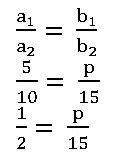
p = 15/2
2. If ax + b = 0 then x =
ax + b = 0 అయిన, x విలువ
(1) – a (2) a (3) b/a (4) – b/a
Answer: (4)
Solution: Given ax + b = 0
⟹ ax = – b
⟹ x = – b/a
3. The solution of system of equations 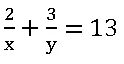 and
and 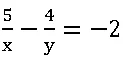 is
is
మరియు సమీకరణాల సాధన
(1) (1/4, 1/3) (2) (1/3, 1/4) (3) (1/2, 1/3) (4) (1/3, 1/2)
Answer: (3)
Solution: Given equations are and
Let = a and = b
⟹2a + 3b= 13 and 5a – 4b = – 2
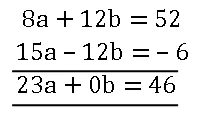
a = 46/23 = 2
2(2) + 3b= 13
4 + 3b= 13
4 + 3b= 13 – 4
3b= 9
b= 3
⟹ x = 1/2, y = 1/3
4. The line x = 7 is
x = 7 అను రేఖ
(1) Parallel to X – axis (X – అక్షమునకు సమాంతరము)
(2) Parallel to Y -Axis ( Y – అక్షమునకు సమాంతరము)
(3) Passes through the origin (మూల బిందువు గుండా పోతుంది)
(4) Passes through (0, 7) ( (0, 7) బిందువు గుండా పోతుంది)
Answer: (2)
Solution: The line x = 7 is parallel to the Y–axis
5. The two lines 2x + 3y = 7, 8x + 12y = 1are ______ Lines.
2x + 3y = 7, 8x + 12y అను రేఖలు ____ రేఖలు
(1) Perpendicular (లంబ)
(2) Parallel (సమాంతర)
(3) Intersecting (ఖండన )
(4) None(ఏది కాదు)
Answer: (2)
Solution: Given lines are 2x + 3y = 7, 8x + 12y = 1are have no solution
a1 = 2; b1 = 3; c1 = 7
a2 = 8; b2 = 12; c2 = 1
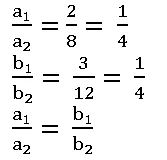
Given lines are parallel
Quadratic Equations
1. If the equation 3x2 + 2x + k=0 has real roots then k is
3x2 + 2x + k=0 సమీకరణము వాస్తవ మూలాలు కలిగి ఉన్నచో k విలువ
(1) k < 1/3 (2) k > 1/3 (3) k ≤ 1/3 (4) k ≥1/3
Answer: (3)
Solution: Given Equation is 3x2 + 2x + k=0
a = 3, b = 2, c = k
The given equation has real roots
b2 – 4ac ≥ 0
22 – 4(3)(k) ≥ 0
4 – 12k ≥ 0
4(1 – 3k) ≥ 0
1 – 3k≥ 0
1 ≥3k
k ≤ 1/3
2. The condition a2 + bx + c = 0 to be a quadratic equation is
a2 + bx + c = 0 ఒక వర్గ సమీకరణము కావలెను అనిన నియమము ఏది?
(1) a ≠ 0, a, b, c∈ R (2) a = 0, b = 0, c ≠ 0
(3) a = 0, b ≠ 0, c ≠ 0 (4) a = b= c = 0
Answer: (3)
3. If the roots of the quadratic equation px² + qx + r = 0, are equal then q2 =
px² + qx + r = 0 వర్గ సమీకరణము యొక్క మూలాలు సమానమైన q2 =
(1) 2pr (2) 3pr (3) 4pr (4) 8pr
Answer: (2)
Solution: Roots of the quadratic equation px² + qx + r = 0 are equal
q2 – 4pr = 0 ⟹ q2 = 4pr
4. The sum of roots of the quadratic equation 3x²– 6x + 1=0 is
3x²– 6x + 1=0 వర్గ సమీకరణము యొక్క మూలాల మొత్తము
(1) 2 (2) 3± √6 (3) – 3 (4) 1/3
Answer: (1)
Solution: Equation is 3x²– 6x + 1=0
a = 3, b = – 6, c = 1
sum of roots = – b/a = – (6)/3 =2
Progressions
1. Find the 10th term of the AP 5, 1, 2, – 3, – 7,…… is
5, 1, 2, – 3, – 7,…… అంక శ్రేడి యొక్క 10 వ పదం
(1) – 31 (2) 31
(3) – 27 (4) – 35
Answer: (1)
Solution: Given AP is 5, 1, 2, – 3, – 7,……
a = 5, d = 1 – 5 = – 4
10th term = a + 9d
= 5 + 9(– 4)
= 5 – 36
= – 31
2. If a, b, c are in GP, then a/b =
a, b, c లు గుణ శ్రేడి లో ఉన్నచో a/b =
(1) b/c (2) c/b (3) b/a (4) c/a
Answer: (1)
Solution: Given a, b, c are in GP
a2/a1 = a3/a1
b/a = c/b
⟹ a/b = b/c
3. If the 2nd term and 5th term of a GP are 24, 81 then the r =
గుణ శ్రేడి లో 2 వ పదం మరియు 5 వ పదం 24, 81అయితే r =
(1) 16 (2) 3 (3) 20 (4) 3/2
Answer: (4)
Solution: Given a2 = 24, a5 = 81
ar = 24
ar4 = 81
ar4/ar = 81/24
r3 = 27/8
r = 3/2
4. Which term of P. √3, 3, 3√3,………. is 729
√3, 3, 3√3,………. గుణశ్రేఢిలో ఉంటే 729 ఎన్నవ పదము
(1) 10 (2) 12 (3) 14 (4) 16
Answer: (2)
Solution: Given G.P.is √3, 3, 3√3,……….
a = √3, r = 3/√3 = √3
an = 729
arn – 1 = 36
arn – 1 = 36
(√3) (√3)n – 1 = 36
(√3)n = 36
(31/2)n = 36
3n/2 = 36
n = 12
12th term of the given G.P. is 729
5. The sum of first 100 natural numbers is
మొదటి 100 సహజ సంఖ్యల మొత్తము
(1) 2250 (2) 5100 (3) 5000 (4) 5050
Answer: (4)
Solution:
We know that sum of first n natural number = [n(n + 1)]/2
sum of first 100 natural number = [100(100 + 1)]/2
= 50(101)
= 5050
Coordinate Geometry
1. If three points (8, 1), (k, – 4) and (2, – 5) are collinear, the k =
(8, 1), (k, – 4) మరియు (2, – 5) బిందువులు సరేకీయాలు అయితే k =
(1) 4 (2) 3 (3) 2 (4) 1
Answer: (2)
Solution: Given that the points A(8, 1), B(k, – 4) and C(2, – 5) are collinear
Slope of AB = Slope of BC
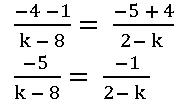
5(2 – k) = k – 8
10 – 5k = k – 8
6k = 18 ⟹ k = 3
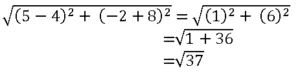
2.The distance between the points (4, –8) and (5, –2) is
(4, –8) మరియు (5, –2) బిందువుల మధ్య దూరం ఎంత?
(1) √101 (2) √35 (3) √37 (4) √181
Answer: (3)
Solution:
3. In the following equations, the line passing through (0, 0) is
క్రింది సమీకరణాల్లో , (0, 0) గుండా వెళుతున్న రేఖ
(1) y = mx (2) y = mx – c (3) y = mx + c (4) y = c
Answer: (1)
Solution: The line passing through the (0, 0)is y = mx
4. The points of intersection of the lines 2x + 3y – 5 = 0and 3x – 4y + 1 = 0 lies in which quadrant?
2x + 3y – 5 = 0 మరియు 3x – 4y + 1 = 0 రేఖల ఖండన బిందువు ఏ పాదం లో ఉండును?
(1) III (2) IV (3) I (4) II
Answer: (3)
Solution: Given equations are 2x + 3y – 5 = 0and 3x – 4y + 1 = 0
2x + 3y – 5 = 0
3x – 4y + 1 = 0
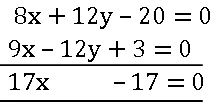
x = 1
2(1) + 3y – 5 = 0
2 + 3y – 5 = 0
3y – 3 = 0
y= 1
Point of intersection of given lines is (1, 1) ∈ I
Similar Triangles
1. In the below figure, PQ∥BC. If AP = 3m, BP = 2cm and CQ = 3cm, then AQ =
ఈ క్రింది పటంలో AP = 3 సెం.మీ. BP = 2 సెం.మీ. మరియు CQ = 3 సెం.మీ. అయిన AQ =

(1) 4 cm (2) 4.5 cm (3) 3.5 cm (4) 5 cm
Answer: (2)
Solution: Given PQ∥BC
By B.P.T
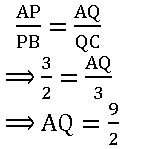
⟹ AQ = 4.5 cm
2. If the ratio of corresponding sides of two similar triangles is 4:9, then the ratio of areas of these triangles is
రెండు సరూప త్రిభుజాల అనురూప భుజాల నిష్పత్తి 4:9 అయితే , ఈ త్రిభుజాల వైశాల్యాల నిష్పత్తి.
(1) 16:81 (2) 4:9 (3) 2:3 (4) √2:√3
Answer: (1)
Solution: Given the ratio of corresponding sides of two similar triangles is 4:9
Ratio of areas of triangles = (4/9)2 = 16/81 = 16:81
3. In the below figure, ∠ADE = ∠CBA, if AD = 3.8 cm, AE = 3.6cm, BE = 2.1 cm and BC = 4.2 cm, then DE =
ఈ క్రింది పటం లో, ∠ADE = ∠CBA, AD = 3.8 సెం.మీ., AE = 3.6 సెం.మీ., BE = 2.1 సెం.మీ మరియు BC = 4.2 సెం.మీ. అయిన DE =

(1) 2.8 cm (2) 2.1 cm (3) 3 cm (4) 3.8 cm
Answer: (1)
Solution: Given ∠ADE = ∠CBA, if AD = 3.8 cm, AE = 3.6cm, BE = 2.1 cm and BC = 4.2 cm
Clearly ∆ ABC ~ ∆ ADE
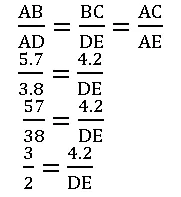
3DE = 2 × 4.2
DE = 2 × 1.4 = 2.8
4. In a trapezium ABCD with AB∥DC and diagonals intersect each other at ‘O’. If AB = 2CD, then the ratio of areas of triangles COD and AOB is…
కింది పటం ట్రెపీజియం ABCD లో AB∥DC మరియు దాని కారణాలు పరస్పరం అనే బిందువు వద్ద ఖండించు కొంటాయి. AB = 2CD, అయితే , త్రిభుజంలు COD మరియు AOB ల వైశాల్యాల నిష్పత్తి…

(1) 2:1 (2) 1:2 (3) 1:4 (4) 4:1
Answer: (3)
Solution: Given ABCD is a trapezium in which AB∥ DC
By A.A similarity
∆COD ~ ∆AOB
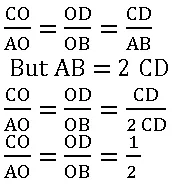
But AB = 2 CD
The ratio of the areas of triangles COD and AOB
= (1/2)2 = 1/4 = 1:4
5. ∆ABC ~ ∆DEF and their areas are respectively 81cm2 and 225 cm2; if EF = 5cm, then BC =
∆ABC ~ ∆DEF మరియు వాటి వైశాల్యాలు వరుసగా 81చ.సెం.మీ. మరియు 225 చ.సెం.మీ EF = 5 సెం.మీ. అయితే BC =
(1) 3 cm (2) 9 cm (3) 10 cm (4) 5 cm
Answer: (1)
Solution: Given ∆ABC ~ ∆DEF
Ar(∆ABC) = 81 cm2; Ar(∆DEF) = 225 cm2 and EF = 5 cm
Ar(∆ABC)/ Ar(∆DEF) = 81 / 225
(BC)2/ (EF)2 = 81 / 225
BC/EF= 9 / 15
BC/5 = 9 / 15 ⟹ BC = 3
Tangents and Secants to a Circle
1. A circle with centre ‘O’, ‘P’ is a point outside the circle and PA and PB are two tangents to the circle at the point of contacts ‘A’ and ‘B’ from ‘P’. If the length of PA = 10 cm, then the length of PB =
O’ కేంద్రముగా గల వృత్తానికి ‘P’ అనే బిందువు బాహ్యంలో కలదు. ‘P’ బిందువు గుండా వృత్తానికి ‘A’ మరియు ‘B’ స్పర్శ బిందువుల వద్ద గీసిన స్పర్శ రేఖలు PA మరియు PB. PA పొడవు = 10 సెం.మీ. అయిన, PB పొడవు = …..
(1) 5 cm (2) 20 cm (3)10 cm (4) 2.5 cm
Answer: (3)
Solution:
We know that tangents drawn from an external point to a circle are equal in length:

PA = PB
Given PA = 10 cm , then PB = 10 cm .
2. A tangent at a point ‘A’ of a circle of radius 7cm meets a line through the centre ‘C’ at a point ‘B’ so that CB = 11cm , then the length of AB =
7 సెం.మీ. వ్యాసార్థం ఉన్న వృత్తా న్ని AB స్పర్శరేఖ ‘A’ వద్ద తాకింది. వృత్త కేంద్రం ‘C’ నుండి స్పర్శరేఖ పై గల బిందువు ‘B’ కు గల దూరం CB = 11 సెం.మీ. అయిన, AB పొడవు = ….
(1) √71 cm (2) 6√2 cm (3) 9 cm (4) 12 cm
Answer: (2)
Solution:

Given BC = 11cm, AC = 7cm
BC2 = AC2 + AB2
112 = 72 + AB2
121 = 49 + AB2
AB2 = 121 – 49 = 72
AB = √72 = 6√2
3. In the figure, if AP and AQ are the two tangents to a circle with centre ‘O’ so that, ∠OQP = 150, then ∠QAP =
క్రింది పటం లో ‘O’ కేంద్రముగా గల వృత్తానికి AP మరియు AQ లు రెండు స్పర్శరేఖలు మరియు ∠OQP = 150 అయిన, ∠QAP =
(1) 150 (2) 600 (3) 300 (4) 450
Answer: (30)
Solution:

In △OPQ, ∠OQP = 150
OP = OQ
∠OQP =∠OPQ =150
∠QOP = 180 – 30 = 150
We know that ∠QAP + ∠QOP = 1800+
∠QAP = 180 – 150 = 30
5. The angle between a tangent to a circle and the radius drawn at the point of contact is
క్రింది ఒక వృత్త స్పర్శరేఖకు, స్పర్శ బిందువు గుండా గీసిన వ్యాసార్థానికి మధ్య కోణం
(1) 1800 (2) 900 (3) 450 (4) 600
Answer: (2)
Solution: We know that the angle between a tangent to a circle and the radius drawn at the point of contact is 900
6. If the angle of a sector is 300, then the area of a sector of the circle with radius 7 cm is (Use π = 22/7)
వృత్తం యొక్క వ్యాసార్థం 7 సెం.మీ. మరియు సెక్టరు కోణం 300 అయితే, సెక్టరు వైశాల్యము ….
( π = 22/7గా తీసుకొనుము).
(1) 77/6 cm2 (2) 77/8 cm2 (3) 132/7 cm2 (4) 154/6 cm2
Answer: (1)
Solution:
Area of sector = (θ/360) × πr2
=(30/360) × (22/7)(7)2
= 1/12 × 154 = 77/6 cm2
7. .Find the area of the shaded region in the figure, if ABCD is a square of side 14 cm, APD and BPC are semicircles
(use 𝜋 = 22 /7 ).
క్రింది పటములో ABCD చతురస్ర భుజం 14 సెం.మీ. APD మరియు BPC అర్ధ వృత్తాలు, అయిన షేడ్ చేసిన ప్రాంత వైశాల్యము కనుగొనుము ( 𝜋 = 22 /7 గా తీసుకొనుము).
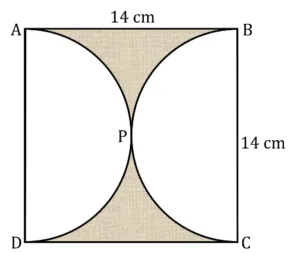
(1) 10.5 cm2 (2) 21 cm2 (3) 42 cm2 (4) 154 cm2
Answer: (3)
Solution:
Area of square = 14 × 14 = 196 cm2
Area of two semicircles = Area of circle
= πr2
= (22/7)(7)2
=154
Area of shaded portion = Area of square – area of circle
= 196 – 154 = 42cm2
Mensuration
1. If a right circular cylinder has base radius 7 cm and height 10 cm, then its volume is …… (use 𝜋 = 22 /7).
ఒక క్రమ వృత్తాకార స్థూపం యొక్క భూ వ్యాసార్ధం 7 సెం.మీ. మరియు ఎత్తు 10 సెం.మీ. కలిగి ఉంటే, దాని ఘన
పరిమాణము …… ( 𝜋 = 22 /7 గా తీసుకొనుము)
(1) 154 cm3 (2) 440 cm3 (3) 4400 cm3 (4) 1540 cm3
Answer: (4)
Solution:
Given radius of cylinder = 7cm and height = 10m
Volume of cylinder = πr2h
= (7)2 × 10
= 154× 10
= 1540 cm3
2. Which vessel shown in the If the radius of a sphere is 5 cm , then the volume and total surface area of a sphere are respectively …… (use 𝜋 = 22 /7)
ఒక గోళం యొక్క వ్యాసార్ధం 3.5 cm సెం.మీ. అయితే, గోళం యొక్క ఘనపరిమాణం మరియు సంపూర్ణతల వైశాల్యాలు వరుసగా …… ( 𝜋 = 22 /7గా తీసుకొనుము)
(1) 539/6 cm3; 77cm2 (2) 343/8 cm3; 147/2cm2
(3) 539/3 cm3; 49cm2 (4) 539/3 cm3; 154cm2
Answer: (4)
Solution:
Given radius of sphere = r = 3.5 cm
Volume of Sphere = πr3 = (22/7) (3.5)3
= (22/7) (7/2)3
= (22/7)×343/8
= 539/3
Surface area of sphere = 4πr2 = 4(22/7) (3.5)2
= 4(22/7) (7/2)2
= 4(22/7) (49/4)
= 154 cm2
3. If the ratio of base radii of right circular cylinder and cone is 2∶3 and the ratio of their heights is 3∶4 , then the ratio of their volumes is …
క్రమ వృత్తాకార స్థూపం మరియు శంకువు యొక్క భూ వ్యాసార్ధాల నిష్పత్తి 2 ∶ 3 మరియు వాటి ఎత్తుల నిష్పత్తి 3 ∶ 4 అయితే, వాటి ఘన పరిమాణాల నిష్పత్తి …..
(1) 1:1 (2) 4:1 (3) 9:8 (4) 1:3
Answer: (1)
Solution:
Ratio of radii = r1:r2 =2∶3
r1/r2 =2/3
Ratio of heights = h1:h2 =3∶4
h1/h2 = 3/4
Ratio of volumes = π (r1)2 h1 : 1/3π (r2)2 h2
Ratio of volumes = 3 (2/3)2 ×(3/4)
Ratio of volumes = 3 (4/9) ×(3/4)
Ratio of volumes = 36/36 = 1/1 = 1:1
4. If the total surface area of the cube is 864 cm², then its volume is …..
సమఘనం యొక్క సంపూర్ణతల వైశాల్యం 864 చ.సెం.మీ. అయితే, దాని ఘన పరిమాణము …..
(1) 144 cm3 (2) 1728 cm3 (3) 3147 cm3 (4) 576 cm3
Answer: (2)
Solution:
Total surface area = 6a2 = 864
a2 = 864/6
a2 = 144
a = 12
volume of cube = a3
volume of cube = (12)3
volume of cube = 1728 cm3
Trigonometry
1. In any ∆ABC, the value of sin [(A + B)]/2
ఏదైనా ∆ABC లో sin[(A + B)]/2 యొక్క విలువ
(1) sin (C/2) (2) cos (C/2) (3) sin [(A – B)/2] (4) cos [(A – B)/2]
Answer: (1)
Solution:
In any ∆ABC
A + B + C = 1800
A/2 + B/2 + C/2 = 900
A/2 + B/2 + = 900 – C/2
Sin [(A + B)]/2 = sin[(900 – C)/2]
= cos (C/2)
2. The value of cos 600 cos 300 – sin 600 sin 300
cos 600 cos 300 – sin 600 sin 300 యొక్క విలువ = ____________
(1) 1/2 (2) √3/2 (3) 0 (4) 1
Answer: (3)
Solution:
We know that cos A cos B – sinA sinB = cos ( A + B)
cos 600 cos 300 – sin 600 sin 300 = cos ( 600 + 300)
= cos (900)
= 0
3. If sec θ = 2/√3, then cos θ =
sec θ = 2/√3 అయిన cos θ =
(1) √3/2 (2) 2/√3 (3) 1/√2 (4) 1/√3
Answer: (3)
Solution:
Given sec θ = 2/√3
We know that sec θ = 1/cos θ
cos θ = 1/sec θ
= √3/2
4. The value of is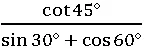
యొక్క విలువ
(1) 2 (2) –2 (3) 1 (4) – 1
Answer: (3)
Solution:
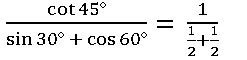
= 1
5. The value of 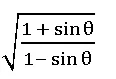
యొక్క విలువ
(1) sec θ + tan θ (2) cos θ + sin θ (3) sec θ + cos θ (4) sin θ + tan θ
Answer: (1)
Solution:
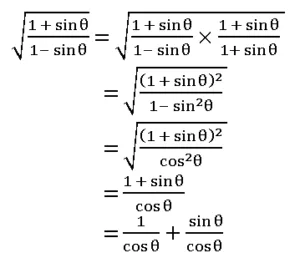
= sec θ + tan θ
6. The value of tan 260. tan 640 is
tan 260. Tan 640 యొక్క విలువ
(1) – 1 (2) 1 (3) 2 (4) –2
Answer: (4)
Solution:
tan 260. tan 640 = tan 260. tan (90 – 260)
= tan 260. cot 260
= 1 [tan θ cot θ = 1]
Application of Trigonometry
1. The angle of elevation of the top of the tower, whose height is 15m , at a point whose distance from the base of the tower is 15 m is:
15 మీ. ఎత్తైన స్తంభంను దాని అడుగు భాగం నుండి 15 మీ. దూరంలో నుండి పరీక్షించిన, స్తంభం పై భాగం భూమితో చేయు ఊర్ధ్వ కోణము:
(1) 150 (2) 450 (3) 300 (4) 600
Answer: (2)
Solution:

Given AB = 15, BC = 15
In ∆ABC
Tan θ = AB/BC = 15/15 = 1
⟹ θ = 450
2. The angle of elevation of top of the cliff from a point 300 m from its foot is 60°. Then the height of the cliff is:
ఒక కొండ అడుగు భాగం నుండి 300 మీటర్ల దూరం నుండి కొండ పై భాగంను 60° ఊర్ధ్వ కోణంతో చూసిన, కొండ ఎత్తు:
(1) 300√3 (2) 200√3 3) 300/√3 (4) 200/√3
Answer: (1)
Solution:

In ∆ABC
tan 60 = AB/BC
⟹ √3 = AB/300
AC = 300√3
3. A person is flying a kite at a height of 30m from the horizontal level. The length of string from the kite to the person is 60m. Assuming that there is no slack in the string, the angle of elevation of kite to the horizontal level is:
ఒక వ్యక్తి క్షితిజ సమాంతర స్థాయి నుండి 30 మీటర్ల ఎత్తులో గాలిపటం ఎగురవేస్తున్నాడు. గాలి పటం తీగ ఎక్కడ కూడా వదులుగా లేకుండా ఉండి, ఆ వ్యక్తి నుండి గాలిపటం తీగ యొక్క పొడవు 60 మీ. అయిన ఆ గాలిపటం క్షితిజ సమాంతర స్థాయితో చేయు కోణము:
(1) 600 (2) 450 3) 300 (4) 900
Answer: (3)
Solution:

Given Hight of kite = AB = 30m
Length of string = AC = 60m
In ∆AEF
sin θ = AB/AC
= 30/60
= 1/2
θ = 300
Probability
1. Two events E1 and E2 are mutually exclusive, then E1∩ E2 =
E1 మరియు E2 లు పరస్పర వర్జిత సంఘటనలు అయిన, E1∩ E2 =
(1) 5 (2) 1 (3) ∅ (4) 0.5
Answer: (3)
Solution: If E1 and E2 are mutually exclusive events then E1∩ E2 = ∅
2. If P(A) = 4/15, then P( ) =
P(A) = 4/15 అయిన P( ) =
(1) 13/15 (2) 11/15 (3) 19/15 (4) 14/15
Answer: (2)
Solution: Given P(A) = 4/15,
P( ) = 1 – P (A)
= 1 – 4/15
= (15 – 4)/15 = 11/15
3. A box contains 7 red marbles and 9 green marbles. If a marble is drawn at random from the box, then the probability of not getting a red marble is:
ఒక పెట్టెలో 7 ఎరుపు గోళీలు మరియు 9 పచ్చ గోళీలు కలవు. పెట్టె నుంచి యాదృచ్ఛికంగా ఒక గోళీని తీసిన, అది ఎరుపు గోళీ కానిది అగుటకు గల సంభావ్యత:
(1) 7/16 (2) 5/16 (3) 3/16 (4) 9/16
Answer: (4)
Solution:
Number of red balls = 7
Number of green balls = 9
Total balls = 7 + 9 = 16
Probability of not getting a red ball = probability of getting a green ball
= 9/16
Statistics
1. The empirical relation between Mean, Median and Mode is:
(1) Mode + Median = 4 Median − 3 Mean
(2) Mode − Median = 2 (Median − Mean)
(3) Mode − Median = 2 (Median + Mean)
(4) Mode + Median = 4 Median + 3 Means
సగటు, మధ్యగతము మరియు బాహుళకము యొక్క అనుభావిక సంబంధము:
(1) బాహుళకము + మధ్యగతము = 4 మధ్యగతము – 3 సగటు
(2) బాహుళకము – మధ్యగతము = 2 (మధ్యగతము – సగటు)
(3) బాహుళకము – మధ్యగతము = 2 (మధ్యగతము + సగటు)
(4) బాహుళకము + మధ్యగతము = 4 మధ్యగతము + 3 సగటు
Answer: (2)
2. What is the median of 47, 52, 57, 62, 67, 72, 77, 78?
47, 52, 57, 62, 67, 72, 77, 78 ల మధ్యగతము ఎంత?
(1) 62 (2) 67 (3) 64.5 (4) 69.5
Answer: (3)
Solution:
Given data is 47, 52, 57, 62, 67, 72, 77, 78
AO: 47, 52, 57, 62, 67, 72, 77, 78
Median = (62 + 67)/2 = 129/2 = 64.5
3. Find the missing value of ” p ” from the following table when the arithmetic mean is 3.55.
క్రింది దత్తాంశం యొక్క అంక మధ్యమం 3.55అయిన, ” p ” యొక్క విలువను కనుగొనండి.

(1) 10 (2) 9 (3) 16 (4) 8
Answer: (1)
Solution:

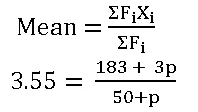
3.55(50 + p) = 183 + 3p
177.5 + 3.55p = 183 + 3p
3.55p – 3p = 183– 177.5
0.55p = 5.5
0.55p = 5.5
p = 10
4. If no value of an ungrouped data is repeated, then which of the following cannot be determined?
ఒక అవర్గీకృత దత్తాంశంలోని విలువలు పునరావృతం కానిచో, ఈ క్రింది వానిలో దేనిని కనుగొనలేము?
(1) median (మధ్యగతము) (2) Mean (సగటు)
(3) mode ((బాహుళకము) (4) none(ఏదీ కాదు)
Answer: (3)
5. The price of the fifteen shares in rupees are as follows:
46, 25, 11, 73, 73, 59, 28, 25, 73, 30, 25, 8, 25, 80, 25. What is the Mode of the price?
పదిహేను షేర్ల యొక్క ధరలు రూపాయిలలో ఈ క్రింది విధంగా ఉన్నాయి:
46, 25, 11, 73, 73, 59, 28, 25, 73, 30, 25, 8, 25, 80, 25. అయితే, ఆ ధరల యొక్క బాహుళకము ఎంత?
(1) 29 (2) 73 (3) 25 (4) 11
Answer: (3)
Solution: The mode is the value that appears most often.
Mode = 25.