
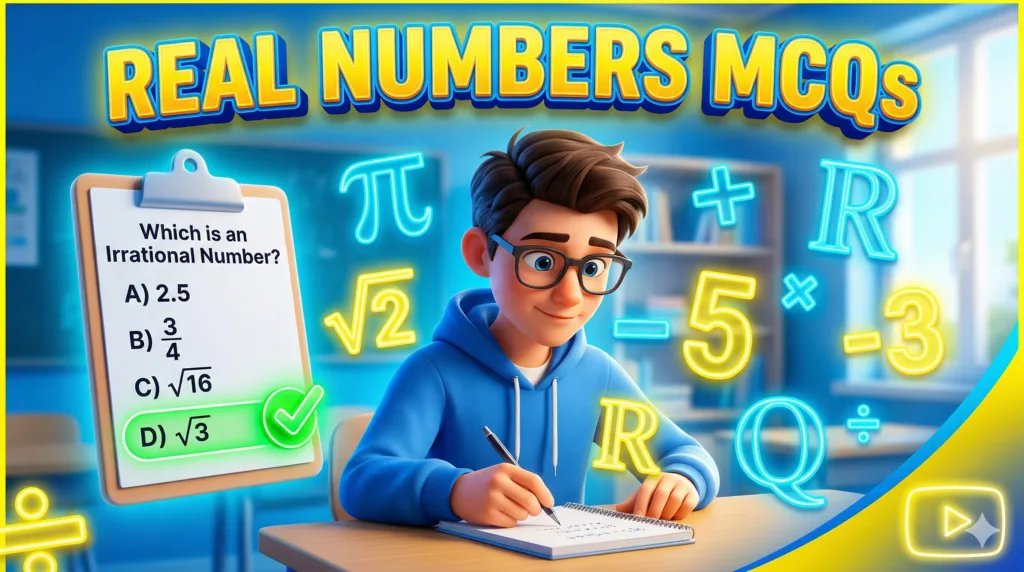
Practice 20 Real Numbers MCQs with answers and simple explanation
Practice 20 Real Numbers MCQs with answers and simple explanations. Ideal for school students and competitive exam preparation.
20 Real Numbers MCQs
1. Which of the following is a real number?
A. √(-9)
B. 3
C. i
D. None
Answer: B
Explanation: Real numbers include all rational and irrational numbers. √(-9) and i are imaginary.
2. Which of the following is an irrational number?
A. 0.125
B. 2/5
C. √10
D. 7
Answer: C
Explanation: √10 cannot be written as a fraction, so it is irrational.
3. Which number has a terminating decimal expansion?
A. 2/3
B. 3/7
C. 5/8
D. 1/9
Answer: C
Explanation: 5/8 = 0.625, which ends, so it is terminating.
4. The decimal expansion of 7/11 is:
A. Terminating
B. Non-terminating non-recurring
C. Non-terminating recurring
D. Integer
Answer: C
Explanation: 7/11 = 0.6363…, which repeats.
5. Which of the following is a whole number?
A. -5
B. 3.5
C. 0
D. 1/2
Answer: C
Explanation: Whole numbers include 0 and positive integers.
6. Which is NOT an integer?
A. -3
B. 0
C. 4
D. 2.5
Answer: D
Explanation: Integers do not include decimal numbers like 2.5.
20 Real Numbers MCQs
7. The HCF of 18 and 24 is:
A. 3
B. 6
C. 9
D. 12
Answer: B
Explanation: Common factors are 1,2,3,6. The highest is 6.
8. The LCM of 5 and 12 is:
A. 60
B. 30
C. 12
D. 24
Answer: A
Explanation: The smallest number divisible by both 5 and 12 is 60.
9. Which property is shown: a × (b + c) = ab + ac?
A. Commutative
B. Associative
C. Distributive
D. Closure
Answer: C
Explanation: Multiplication distributes over addition.
10. Which number lies between √4 and √9?
A. 1
B. 2.5
C. 4
D. 5
Answer: B
Explanation: √4 = 2 and √9 = 3. So 2.5 lies between them.
11. Which of the following is a rational number?
A. √6
B. π
C. 7/9
D. √11
Answer: C
Explanation: 7/9 can be written as p/q, so it is rational.
12. Which statement is true?
A. All rational numbers are whole numbers
B. All integers are rational numbers
C. All irrational numbers are integers
D. None
Answer: B
Explanation: Every integer can be written as a fraction.
13. The product of two rational numbers is:
A. Always irrational
B. Always rational
C. Sometimes irrational
D. None
Answer: B
Explanation: Rational × Rational = Rational.
14. Which of the following is irrational?
A. 0.333…
B. 1/4
C. √13
D. 2
Answer: C
Explanation: √13 cannot be expressed as a fraction.
15. The additive inverse of 7 is:
A. 7
B. -7
C. 1/7
D. 0
Answer: B
Explanation: Additive inverse gives sum zero: 7 + (-7) = 0.
16. Multiplicative inverse of 5 is:
A. 5
B. -5
C. 1/5
D. 0
Answer: C
Explanation: The reciprocal of 5 is 1/5.
17. Which is a prime number?
A. 8
B. 9
C. 11
D. 15
Answer: C
Explanation: 11 has only two factors: 1 and 11.
18. Which is a composite number?
A. 2
B. 3
C. 5
D. 10
Answer: D
Explanation: 10 has more than two factors.
19. The sum of an irrational and a rational number is:
A. Rational
B. Irrational
C. Integer
D. Whole
Answer: B
Explanation: Example: 2 + √3 is irrational.
20. Which of the following is NOT a real number?
A. 4
B. -2
C. √(-16)
D. 0
Answer: C
Explanation: √(-16) is imaginary, not a real number.
YouTube

