

Polynomials Concepts and Practice Questions Guide
Have you ever looked at an algebraic expression and felt confused about what it really means? You’re not alone.
Imagine this: A student preparing for an exam keeps skipping polynomial questions because they “look complicated.” But once they understand just a few simple concepts, those same questions become the easiest marks on the paper.
That’s the power of Polynomials.
In this guide, I’ll break down polynomials in a super simple, friendly way—just like a teacher sitting next to you. By the end, you won’t just understand polynomials… you’ll actually enjoy solving them!
Sets Explained for POLYCET 2026 Master Concepts Fast & Score High
What Are Polynomials?
An algebraic expression becomes a polynomial if the powers of the variable(s) are whole numbers
Example: 2x – 5, 3x2 + 5x – 3 , x3 + 3x2 – 6x + 3
Value of a polynomial
p(a) is the value of a polynomial p(x) at x = a, whre a is any real number
Ex: let p (x) = 2x + 5
Put x = 1 ⟹ p (1) = 2 (1) + 5 = 2 + 5 = 7
∴ 7 is the value of the polynomial p(x) at x = 1
Zero of a polynomial
Zero of a polynomial p(x) is any real number ‘k’ such that p(k) = 0.
Ex: let p (x) = x + 5
Put x = 5 ⟹ p (– 5) = – 5 + 5 = 0
∴ – 5 is the zero of the polynomial p(x)
Note: For finding the zeroes of the polynomial p(x), let p(x) = 0
Degree of a polynomial
The highest power of x in a polynomial p(x) is called the degree of the polynomial p(x)
Example: Degree of the polynomial 3x2 – 4x is 2
Degree of the polynomial x3 – 4x4 – 5x + 6 is 4
Types of Polynomials
According to Terms
1. Monomial: If a polynomial has only one term, then it is called a monomial.
Example: 2x, 3y, -5x, 9x3
2. Binomial: If a polynomial has two terms, then it is called a Binomial.
Example: 2x + 1, 3y – 7, -5x + 6, x5 + 5x3
3. Trinomial: If a polynomial has three terms, then it is called a Trinomial.
Example: x5 + 5x3+ 2x, 3y2 – 8y2 + 3
According to the degree
1. Linear Polynomial: If a polynomial has a degree of one, then it is called a Linear Polynomial.
Example: 2x + 1, 3y – 1,
2. Quadratic Polynomial: If a polynomial has a degree of two, then it is called a Quadratic Polynomial.
Example: 2x2 + x + 1, y2 – 7, -x2 + 6,
3. Cubic Polynomial: If a polynomial has a degree of three, then it is called a Cubic Polynomial.
Example: 5x3+ 2x, 9y3 – 8y2 + 3
Note:
For any quadratic polynomial ax2 + bx + c, a ≠ 0, the graph of the corresponding equation y = ax2 + bx + c (a ≠ 0,) either opens upwards like ∪ or opens downwards ∩ as This depends on whether a > 0 or a< 0.
The shape of these curves is called a parabola
Graphical Representation of a Quadratic Polynomial
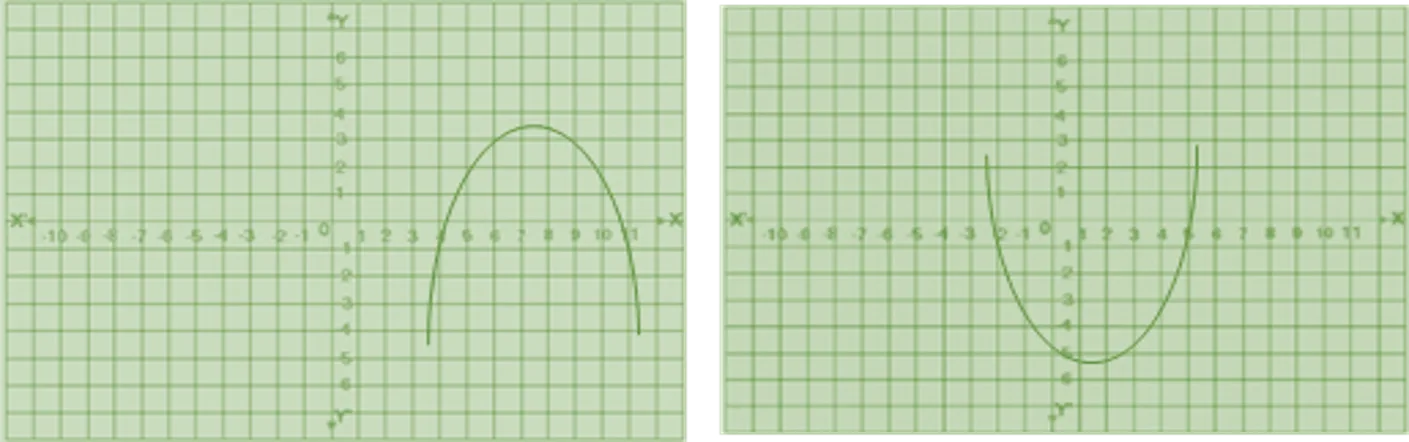
The shape of the graph of y = ax2 + bx + c, (a ≠ 0), the following three cases arise.
Case (i) :
Here, the graph cuts X – axis at two distinct points. In this case, the x-coordinates of those two points are the two zeroes of the quadratic polynomial ax2 + bx + c. The parabola opens either upward or downward.
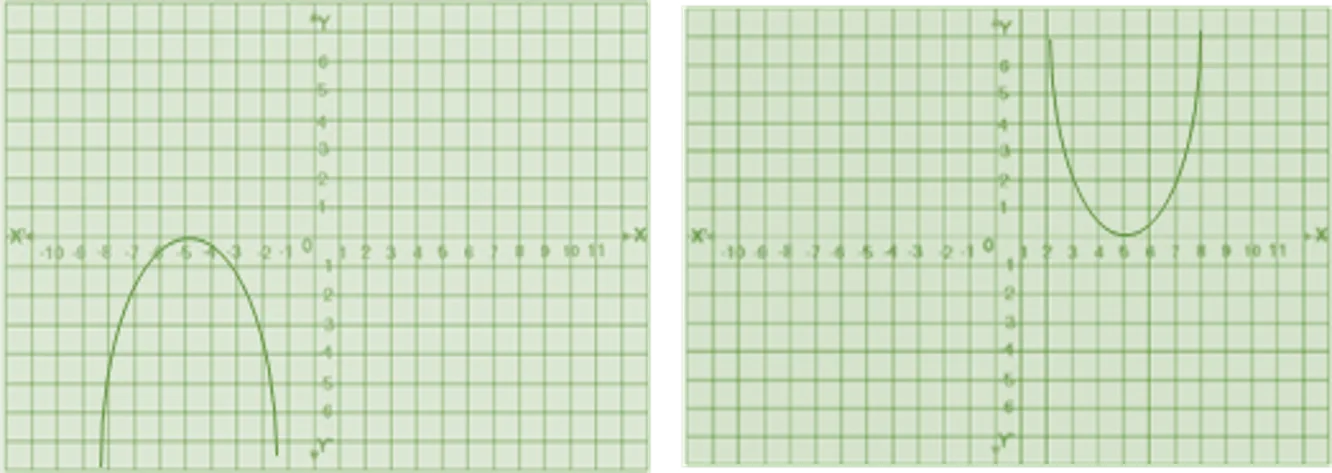
Case (ii) :
Here, the graph touches X – axis at exactly one point. In this case, the x-coordinate of that point is the only zero for the quadratic polynomial ax2 + bx + c.
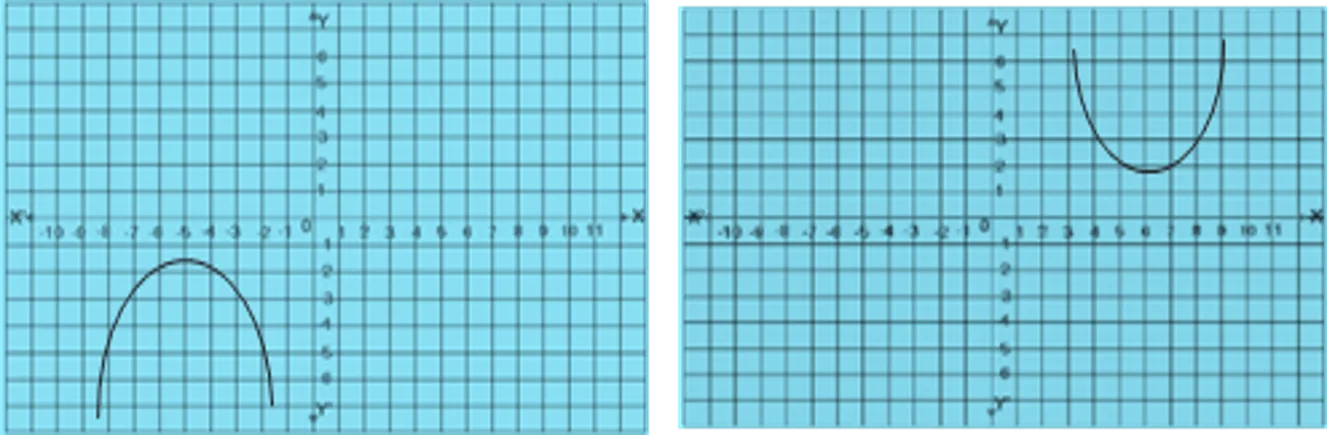
Case (iii) :
Here, the graph is either completely above the X-axis or completely below the X – axis.
So, it does not cut the X-axis at any point.
The quadratic polynomial ax2 + bx + c has no zero in this case.
Relationship Between Zeros and Coefficients of the polynomial:
1. P(x) = ax + b is linear polynomial
zero of the polynomial is x = −b/a = -(constant)/ x coefficient
2. P(x) = ax2 + bx + c (a ≠ 0) is the general form of a quadratic polynomial.
Sum of the zeroes = α + β = −b/a = -(x coefficient)/ x2 coefficient
Product of the zeroes =−b/a = (constant)/ x2 coefficient
3. p(x) = ax3 + bx2 + cx + d ( a ≠ 0)is the general form of a cubic polynomial.
α + β + γ = −b/a = -(x2 constant)/ x3 coefficient
αβ + βγ + γα = −b/a = (x constant)/ x3 coefficient
α β γ = −−b/a = -(constant)/ x3 coefficient
- If α and β are the zeroes of a quadratic polynomial, then its form is k [x2 – (α + β ) x + α β]
- If α, β and γ are the zeroes of the cubic polynomial, then its form is
k [x3 – (α + β + γ) x2 +( αβ + βγ +γα )x – αβγ]
Polynomials Concepts and Practice Questions
Division Algorithm for the polynomials:
If p(x) and g(x) are any two polynomials with g(x) ¹ 0, then we can find polynomials
q(x) and r(x) such that p(x) = g(x) × q(x) + r(x),
Where either r(x) = 0 or degree of r(x) < degree of g(x) if r(x) ≠ 0
We have the following results from the above discussions
(i) If g(x) is a linear polynomial then r(x) = r is a constant.
(ii) If degree of g(x) = 1, then degree of p(x) = 1 + degree of q(x).
(iii) If p(x) is divided by (x – a), then the remainder is p(a).
(iv) If r = 0, we say q(x) divides p(x) exactly or q(x) is a factor of p(x)

Polynomials Concepts and Practice Questions
Solved Questions With Answers
1. The zeroes of the quadratic polynomial x2 + 24x + 119 are.
(1) one positive and one negative (2) both positive
(3) both negative (4) none of the above
Answer: ( 3 )
Solution:
x2 + 24x + 119 = x2 + 17x + 7x + 119
= x(x + 17) + 7(x + 17)
= (x + 7) (x + 17)
Zeros are – 7, –17
2. What is the degree of the polynomial 7u6 – 3/2u4 + 6u2 – 8
(1) 7 (2) –3/2 (3) 6 (4) – 8
Answer: ( 3 )
Solution:
The highest power of x in a polynomial p(x) is called the degree of the polynomial p(x)
Degree of the polynomial 7u6 – 3/2u4 + 6u2 – 8 is 6
3. If x3 – 3x2 + 4x + k is exactly divisible by x – 2, then k =
(1) 4 (2) – 4 (3) 0 (4) 1
Answer: ( 2 )
Solution:
P(x) = x3 – 3x2 + 4x + k is exactly divisible by x – 2
⇒ P(2) = 0
(2)3 – 3(2)2 + 4(2) + k = 0
8 – 12 + 8 + k = 0
k = – 4
Polynomials Concepts and Practice Questions
4. The remainder of 3x3 – 2x2 + x + 2 when divided by 3x + 1 is
(1) 4/3 (2) 3/4 (3) – 4/3 (4) None
Answer: ( 4 )
Solution:
P(x) = 3x3 – 2x2 + x + 2
⇒ Remainder = P(–1/3) = 3(–1/3)3 – 2(–1/3)2 + (–1/3) + 2
= – 3/27 – 2/9 – 1/3 + 2
= – 1/9 – 2/9 – 1/3 + 2
= (1– 2 – 3 + 18)/9
= (19 – 5)/9
= 14/9
5. If two zeroes of the polynomial x3 + 3x2 – 5x – 15 are √5 and – √5, then the third zero is
(1) 3 (2) 5 (3) – 3 (4) – 5
Answer: ( 3 )
Solution:
P(x) = x3 + 3x2 – 5x – 15
α + β + γ = -b/a = – 3
√5 – √5 + γ = – 3
γ = – 3
Visit my YouTube channel: Click on the Logo