
Sets Explained for POLYCET: Master Concepts Fast & Score High (2026 Guide)
Sets Explained for POLYCET—Imagine walking into your POLYCET exam hall and spotting a question from Sets… and instead of panic, you smile because you already know the answer in seconds. Sounds powerful, right?
That’s the magic of understanding sets properly.
Many students think sets is a small topic—but here’s the truth: it builds your logical thinking and helps you solve questions quickly with accuracy. In this guide, I’ll break down Sets Explained for POLYCET in the simplest way possible—like a friend teaching you before the exam.
What Are Sets? (Simple Explanation)
A set is a collection of well-defined objects.
These objects are called elements.
Example:
Set of numbers: A = {1, 2, 3, 4}
Set of vowels: B = {a, e, i, o, u}
Important: A set should be clear and specific.
- Elements in a set are written in a curly bracket { } separated by commas
Roster Form of a Set
In a ‘roster form’, we are writing a set by listing the elements in it.
EX: A = {1, 2, 3, 4}; B = {a, e, i, o, u}
Set Builder form of a set
In a ‘Set builder form,’ we write a set by defining its elements with a “Common property“
Syntax for the set builder form

Know about Belongs to
The symbol ‘∈’ is used to denote membership of an element and read as ‘belongs to’
Ex: A = {1, 4, 5, 6}
4 ∈ A, 5 ∈ A, and 7 ∉ A

Sets Explained for POLYCET
Types of Sets You Must Know
Empty Set (Null Set)
- A set with no elements
- Represented as: Ø or {}
👉 Example: Set of odd numbers divisible by 2
A = {x: 1 < x < 2, x is a natural number}
Finite set:
A set that contains a finite number of elements is called a finite set
Ex: A = {1, 2, 3, 6}; B = {x: x ∈ w, 0 ≤ x ≤ 6}
Infinite set:
A set that contains an infinite number of elements is called an infinite set
Ex: N = {1, 2, 3, 4, …}; B = {x : x > 5, x ∈ W}
Venn Diagrams:
It is one method for representing relationships between sets. Venn diagrams are also known as “Venn–Euler diagrams.
These diagrams consist of rectangles and closed curves, such as circles.

μ = {1, 2, 3, 4, 5, 6, 7, 8, 9, 10}
A = {1, 4, 5, 6}; B = {2, 8}
Subset:
For any two sets A and B, if every element of set A is in set B, then we can say that A is a subset of B. It is denoted by A ⊂ B.
Ex: If A = {2, 3} and B = {1, 2, 3, 4}, then we say that ‘A is a subset of B’, and symbolically A ⊂ B.

Note:
- If a set has n elements, then the number of subsets of that set = 2n
- The empty set is a subset of every set
- Every set is a subset of itself
If A ⊂ B, then
- A ∪ B = B
- A ∩ B = A
- A – B = ∅
Power set:
The collection of all possible subsets of a set A is called the power set of A, and it is represented by P(A).
Ex: A = {a, b, c}
Subsets of A are {a}, {b}, {c}, {a, b}, {b, c}, {c, a}, {a, b, c}, ∅
P (A) = {{a}, {b}, {c}, {a, b}, {b, c}, {c, a}, {a, b, c}, ∅}
- If a set A has n elements, then the number of elements of P (A) = 2n
Universal set:
A set that contains all the subsets of it under our consideration is called a universal set.
The universal set is denoted by ‘𝛍’ or ‘U’ and represented by rectangles.

μ = {1, 2, 3, 4, 5, 6, 7, 8, 9, 10, 11, 12}
A = {1, 4, 5, 9} B = {7, 10}
Union of sets:
The union of two sets A and B is the set that contains all the elements of set A or set B, or both sets A and B.
- The symbol ∪ is used to denote the union
- The union of A and B is written as ‘A ∪ B’ and read as ‘A union B’
- A∪B = {x: x ∈ A or x ∈ B}
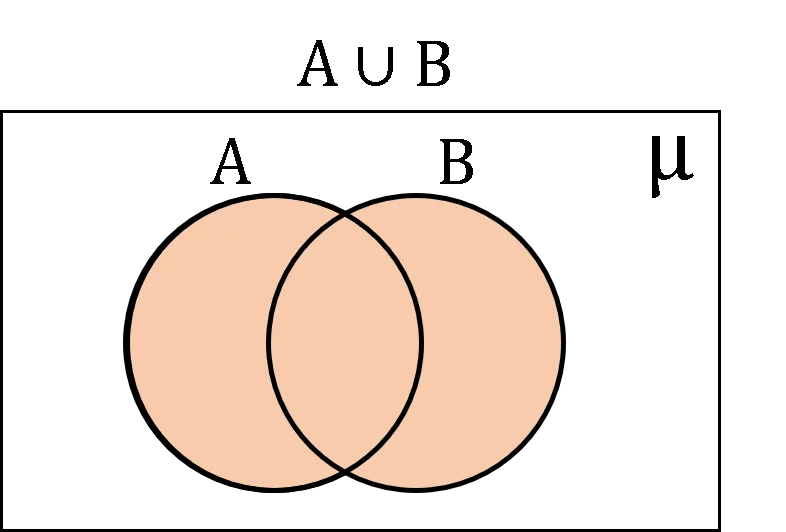
Example
A = {1, 3, 5}, B = {1, 2, 3, 4}
A∪B = {1, 3, 5} ∪ {1, 2, 3, 4} = {1, 2, 3, 4, 5}
Intersection of sets:
The intersection of two sets A and B is the set that contains all the elements that are common to both sets A and B.
- The symbol ∩ is used to denote the union
- The intersection of A and B is written as ‘A ∩ B’ and read as ‘A intersection B’
- A ∩ B = {x: x ∈ A and x ∈ B}

Example
A = {1, 3, 5}, B = {1, 2, 3, 4}
A ∩ B = {1, 3, 5} ∩ {1, 2, 3, 4} = {1, 3}
Disjoint sets:
Two sets A and B are said to be disjoint sets if they have no common element
⟹ A ∩ B = ∅
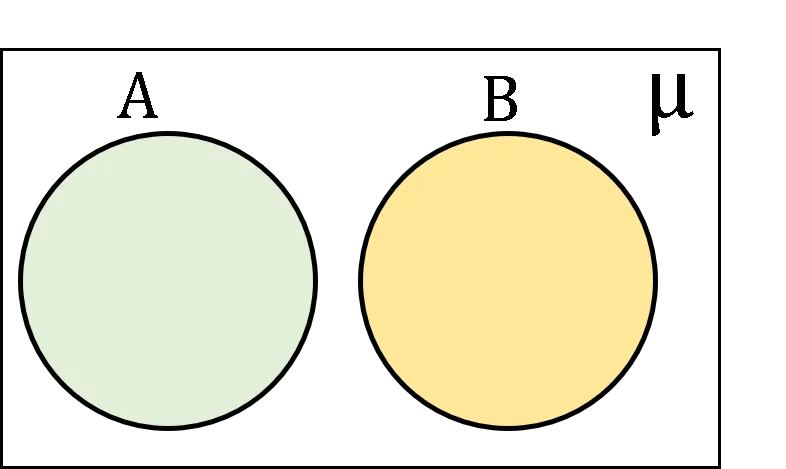
Example
A = {a, b, c}, B = {x, y, z}
A ∩ B = ∅
Difference of sets:
The difference set of sets A and B is the set of elements that belong to A but do not belong to B
The Difference of A and B is Denoted by A – B

A – B = {x: x ∈ A and x ∉ B} B – A = {x: x ∈ B and x ∉ A}
Sets Explained for POLYCET
Cardinal number of a set:
The number of elements in a set A is called the cardinal number of that set. It is denoted by n (A).
Ex: If A = {1, 3, 5, 7, 9}, then n(A) = 5
Equal sets:
Two sets, A and B, are said to be equal sets if they have the same elements.
Equal sets denoted by A = B
Ex: A = {a, b, c}; B = {b, c, a}
∴ A = B
Equivalent sets:
Two sets, A and B, are said to be equivalent sets if n(A) = n(B).
Equal sets denoted by A ~ B or A ≡ B
Ex: A = {3, 4, 5}; B = {a, b, c}
n(A) = 3; n(B) = 3
∴ A~ B
Important Points for Polycet
- n(A∪B) = n(A) + n(B) – n(A ∩ B)
- n(A ∩ B) = n(A) + n(B) – n(A ∪ B)
- If A and B are disjoint sets, then A ∩ B = ∅ and n(A ∩ B) = 0
- If A ⊂ B, then (i) A∪B = B (ii) A∩B = A (iii) A – B = ∅
- x ∈ A∪B ⇒ x ∈ A or x ∈ B
- x ∈ A ∩ B ⇒ x ∈ A and x ∈ B
- x ∈ A – B ⇒ x ∈ A and x ∉ B
- x ∈ B – A ⇒ x ∉ A and x ∈ B
Sets Explained for POLYCET
Solved Questions With Answers
1. If n(A) = 5, n(B) = 5 and n(A∪B) = 8, then n(A ∩ B) =
(1) 2 (2) 3 (3) 1 (4) None
Answer: (1)
Solution
Given n(A) = 5, n(B) = 5 and n(A∪B) = 8
We know that n(A ∩ B) = n(A) + n(B) – n(A∪B)
= 5 + 5 – 8 = 2
2. If A = {x/ x ∈ N, 1 < x < 10}, then n (A) =
(1) 3 (2) 4 (3) 8 (4) None
Answer: (3)
Solution
Given A = {x/ x ∈ N, 1 < x < 10}
A = {2, 3, 4, 5, 6, 7, 8, 9}
n(A) = 8
3. Identify the disjoint sets among the following:
(1) A – B, B – A (2) A – B, A (3) B – A, B (4) None
Answer: (1)
Solution
We know that If A ∩ B = ∅, then A and B are disjoint sets
(A – B) ∩ (B – A) = ∅
A – B and B – A are disjoint sets
4. If A = {1, 2, 3, 4, 5} and B = {4, 5, 6}, then find A ∩ B
(1) A (2) B (3) {4, 5} (4) {1, 2, 3}
Answer: (2)
Solution
Given A = {1, 2, 3, 4, 5} and B = {4, 5, 6}
A ∩ B = {1, 2, 3, 4, 5} ∩ {4, 5, 6} = {4, 5}
5. The cardinal number of set A = {1, 2, 4,} is
(1) 1 (2) 4 (3) 2 (4) 3
Answer: (4)
Solution
Given A = {1, 2, 4}
n(A ) = 3
6. If A = {C, O, V, I, D, 19, 2020} and B = {C, O, V, I, D, 19, 2021}, then B – A = ?
(1) {2020} (2) {2021} (3) {2020, 2021} (4) {C, O, V, I, D, 19, 2021}
Answer: (2)
Solution
Given A = {C, O, V, I, D, 19, 2020} and B = {C, O, V, I, D, 19, 2021}
B – A = {C, O, V, I, D, 19, 2020} – {C, O, V, I, D, 19, 2021} = {2021}
Visit my YouTube channel: Click on the Logo